
Grebs-Niendorf: Motte, circular village and routes
Accommodation in Grebs-Niendorf
Those interested in archaeological history, rural village layouts and routes through a lowland landscape will find plenty to explore in Grebs-Niendorf. Menkendorf is associated with a Slavic motte, while Niendorf an der Rögnitz is considered a particularly attractive circular village. Cycling and riding routes, as well as the fact that part of the municipality lies within a UNESCO Biosphere Reserve, add to these varied impressions.
The motte near Menkendorf
The Slavic motte near Menkendorf is one of Mecklenburg’s best-preserved archaeological sites from the Slavic period. It measures about 300 metres in circumference; the site is almost circular and was built as a timber-and-earth fortification. Its size, shape and construction offer various ways to understand the archaeological site. If you are interested in the history of the Slavic period, the focus here is on specific features rather than just a place name.
You can reach the motte from the centre of Menkendorf after 1 km along a signposted cycling route. The stated distance provides a clear guide for your ride. Check the signs on site before setting off.
Village layout and protected landscape
Grebs-Niendorf lies partly within the UNESCO Biosphere Reserve Flusslandschaft Elbe M-V. For individual places, it is worth checking the exact course of the protected area boundary. The Rögnitz and the Eldekanal surround Grebs-Niendorf; the Eldekanal connects the Elbe with the Müritz and the upper Havel. Thus, the municipality’s landscape brings together a river environment and a waterway with connections to several bodies of water.
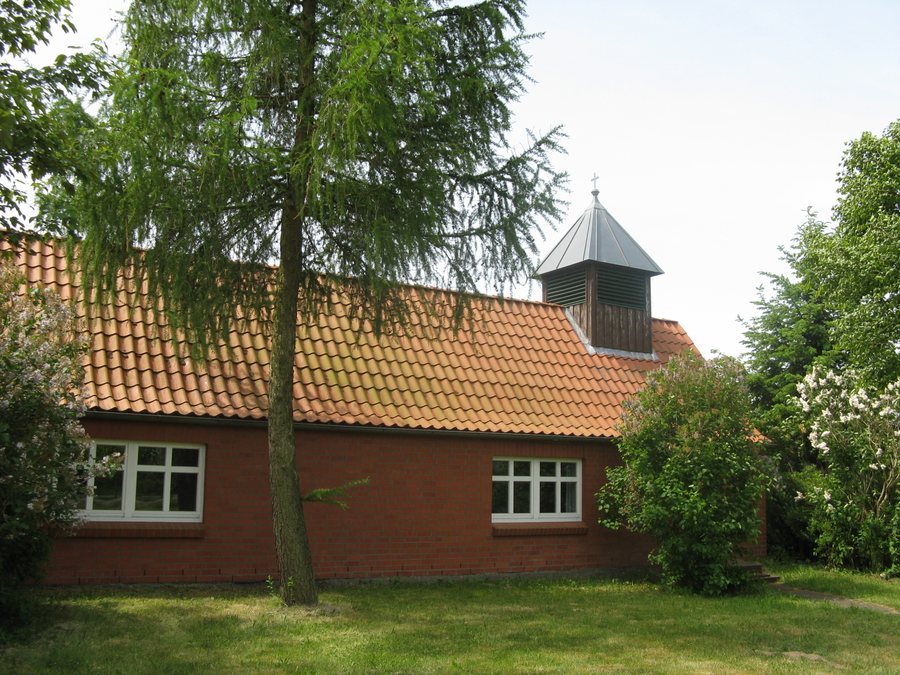
Niendorf an der Rögnitz is considered a particularly attractive circular village. The village is also home to a chapel belonging to the Evangelical Lutheran parish of Conow. Together, the village layout and the chapel offer two different reasons to explore Niendorf: the village’s form and its religious affiliation.
Regional building traditions add another distinctive feature. The area around Grebs-Niendorf has characteristic houses made of bog iron, also known as Klump. The material was smelted at ironworks on the Elde and used as a building material in many places. The motte and bog iron thus draw attention to different architectural traces: a fortification from the Slavic period and a locally used building material.
Routes to Menkendorf and Niendorf
After travelling through the quiet, expansive Rögnitz lowlands, a 1.3 km side road leads to Menkendorf. Check the route conditions before setting off. A riding route reaches Niendorf an der Rögnitz via an old, unpaved farm track; depending on the season, it can be difficult to use. The information therefore varies according to the destination and type of route: a distance is given for the side road to Menkendorf, while the connection to Niendorf is specifically described as a riding route over unpaved ground.
Culture in the wider Ludwigslust-Parchim destination
The wider Ludwigslust-Parchim destination offers further cultural and historical highlights. Ludwigslust Palace was the former residence of the Dukes of Mecklenburg and forms, together with its park and town, an ensemble known as the “Little Versailles of the North.” The palace is the centrepiece of a largely intact late Baroque town plan, with a former court church and an English-style landscape park. Inside, visitors can learn about art and courtly domestic life in the 18th and early 19th centuries. This courtly heritage complements Grebs-Niendorf’s archaeological and regional architectural themes.
In Dömitz, the wider destination brings together fortress architecture and the history of the town and the Elbe. The citadel is a pentagonal Renaissance fortress built on the Italian model, with bastions, casemates and a drawbridge. The fortress museum covers the history of the fortress and town, the history of the Elbe, harbour and bridges, and Fritz Reuter; its themes also include temporary and art exhibitions.
Another cultural highlight is Zarrentin Monastery. The ground floor houses a permanent exhibition about the monastery. Guided tours explore the history of the former Cistercian nunnery, the lives of the nuns and the building’s architecture. Check the current dates and access arrangements before visiting.
Discover more destinations: Neu Kaliß, Karenz, Vielank, Malk Göhren, Dömitz, Malliß.
Go to the overview of the wider destination: Amt Dömitz-Malliß.

