
Łęgowo: Church History and Żuławy Houses
Accommodation in Łęgowo
Łęgowo can be explored through two historical perspectives: St. Nicholas Parish Church and the Żuławy houses. The church brings together architectural history, religious art and relics; the houses tell another story of the area, spanning several decades. If you want to understand Łęgowo through its history, the combination of religious and residential architecture offers a concrete starting point.
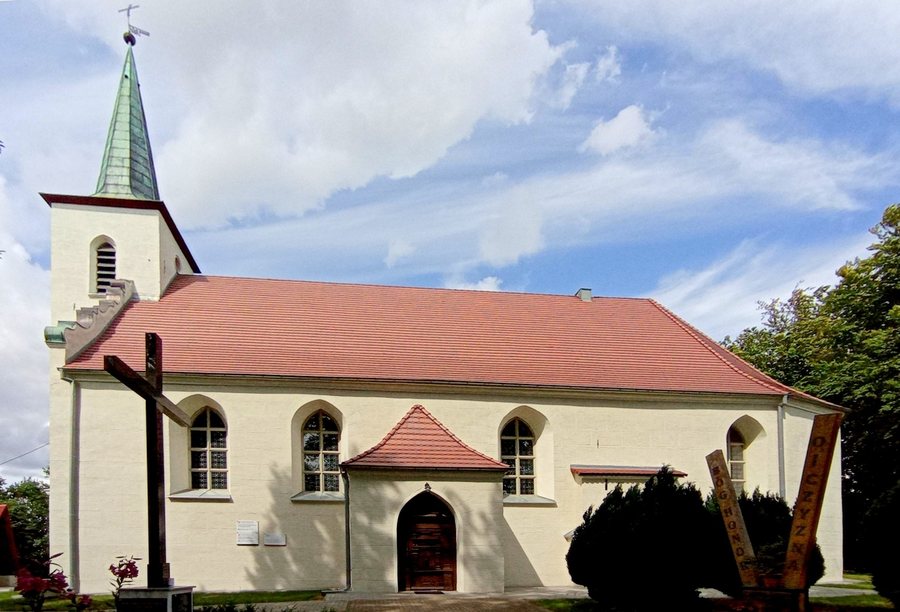
St. Nicholas Church: Architectural and Religious History
The parish church acquired its present appearance through renovations in 1748. Before its destruction, it was Gothic; the interior is Baroque. These details refer to different aspects: the Gothic classification concerns the church before its destruction, the Baroque design the interior, and the renovations the building’s present appearance. Its former form, architectural history and interior design can therefore be considered as distinct perspectives on the church.
The tower has its own architectural history: after a fire in 1862, it was rebuilt in its present form. Two bells from the 17th century hang in it, dated 1625 and 1645. In 1942, the bells were looted and taken to Germany; in 2008, they returned to their place. The dates mark different parts of the story: 1748 concerns the church’s appearance, 1862 the tower’s reconstruction, and 1625 and 1645 the bells. Their journey to Germany and back adds another historical turning point.
The church’s religious associations are also specific: the high altar contains an image of Our Lady, Queen of Poland and Advocate of Reconciliation. On January 15, 2008, Archbishop Tadeusz Gocłowski established the Sanktuarium Matki Bożej Łęgowskiej – Królowej Polski, Orędowniczki Pojednania in Łęgowo. Relics of the True Cross are also kept in the church. Relics of Saint Olivia of Anagni were brought here from Italy in 2013. The high altar image, the establishment of the sanctuary and the relics represent different aspects of the religious heritage.
Żuławy Houses and Inhabited Architectural History
Łęgowo is home to Żuławy houses dating from the mid-19th and early 20th centuries. The buildings are listed as historic monuments and are still inhabited; they are often well maintained and in good condition. Their dates therefore cover more than a single year of construction. Unlike the dated renovations of the church, the houses represent a broader period of residential architecture.
This offers a clear distinction for understanding the area’s history: at the church, individual construction events and dates can be traced, while the Żuławy houses represent a longer period of construction and buildings that remain inhabited. The two perspectives raise different questions about Łęgowo: the changing form of a religious building and houses that are still part of the area. Those interested in history and architecture can consider these themes separately when looking at Łęgowo, without combining them into a single construction period.
Discover More Destinations
Discover more destinations: Sitno, Borkowo, Postołowo, Swibno, Koszwaly, Wiślina, Przejazdowo, Elganowo.
For the main travel overview: Gdańsk.

