
Discover Grabówko
Accommodation in Grabówko
Grabówko brings together two historical themes: the former Evangelical cemetery serving the villages of Grabówko and Grabowo, and the ruins of a road and railway bridge over the Vistula. The cemetery dates from the first half of the 19th century; the bridge remains are dated to around 1915. For travelers who take cultural traces into account when choosing where to go, the village offers a concrete connection to village history and transport structures. You can view these two themes as different ways of exploring Grabówko’s history: a burial ground associated with two villages and a transport structure.
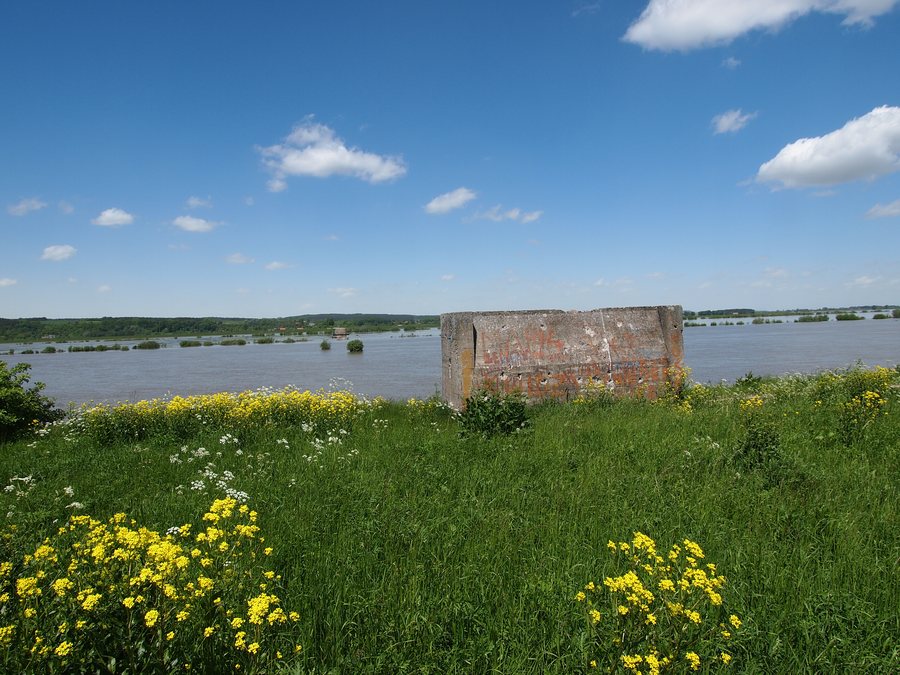 Grabówko, ślady przyczółku wschodniego mostu na Wiśle (1)
Photo: t.przechlewski via Wikimedia Commons, CC BY 3.0
Cemetery and trees
The cemetery is about 80 meters long and 30 meters wide. These approximate dimensions provide a sense of its scale alongside its historical date. It is also associated with the villages of Grabówko and Grabowo. Several aspects therefore come together: its date in the first half of the 19th century, its approximate size, and its connection to both villages. If you are comparing cultural destinations, you can distinguish between their historical period, physical scale, and village connections.
The cemetery also includes its trees. Lime and maple trees shape the site; mature oaks were probably part of the original planting. This landscape perspective complements its historical timeframe and connection to the villages. If you choose historical sites based on more than their dates, the tree species may also help inform your assessment.
Cycling route and bridge ruins
There is also a specific connection for cyclists: the “Szlak Menonitów II” cycling route passes through Grabówko, and the cemetery there is visible from a distance. If you plan to take the route, check its current course before setting out, as route details can change. This adds a practical planning consideration to the village’s history: should your choice also be influenced by a named cycling route? The cemetery’s visibility gives the route a cultural and historical connection without limiting your choice of destination to this one aspect.
The bridge ruins offer a different historical emphasis. They are the remains of a road and railway bridge over the Vistula, dated to around 1915. Road and rail were the stated functions of the same bridge structure; the Vistula is part of its geographical context. Unlike the cemetery, this is about historical infrastructure rather than a burial ground associated with two villages. This creates a clear contrast to consider when choosing what interests you: village history and a cemetery on the one hand, bridge construction and transport on the other. The dates also differ: the cemetery dates from the first half of the 19th century, while the bridge remains are dated to around 1915. You can therefore choose Grabówko based on the theme you want to shape your trip more strongly.
Compare hotels and holiday rentals in Grabówko by price and availability for your travel dates.
Advertisement · We may receive a commission if you book.Discover more destinations
Kwidzyn, Gardeja, Borowy Młyn, Ryjewo, Sadlinki, Rodowo Male, Prabuty, Licze
For the broader travel overview: Marienwerder.

