
Kępice – Paper Industry and Landscape in the Pomeranian Region
Accommodation in Kępice
History
The historic paper production is part of Kępice’s industrial heritage. The historical local context includes a paper mill and its shared appearance with the town’s railway station. The factory represents industrial production, while the railway station represents rail transport; together, both motifs lead to a local history in which production and infrastructure are closely connected. For a cultural and historical perspective, the connection extends from the specific location to the broader Pomeranian context.
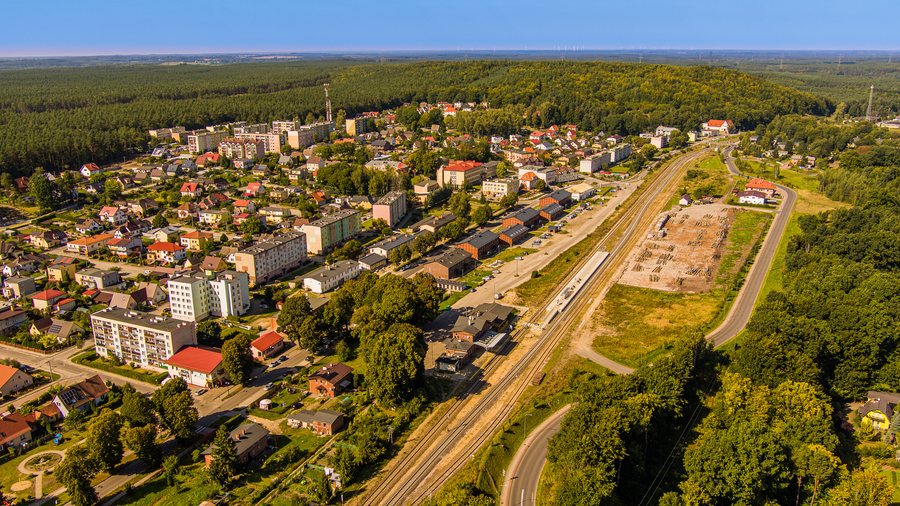
The connection between the paper mill and the railway station anchors the history in two clearly defined local motifs. A paper mill represents the manufacture of an industrial product, while a railway station represents the technical infrastructure of rail transport. In Kępice, these two functions come together in a historical context. The industrial connection is specifically identified and at the same time broadly regional: it encompasses the town itself, the history of production and the transport infrastructure that appears within the same local motif.
The Varzin Paper Mill A.G. is part of the broader historical context of Kępice. It is regarded as a major industrial enterprise in eastern German Pomerania and as a significant manufacturer of banknotes. This supraregional connection links the paper history of Kępice with Eastern Pomerania and with banknote production. The industrial classification is broadly regional and places the local paper mill, the railway station and the banknote production of the Varzin company within a historical context.
Landscape
In the wider regional surroundings of Kępice, Słupsk County is considered a landscape of forests, rivers and lakes. The same regional framework includes opportunities for active tourism as well as marked hiking, cycling and kayaking routes that pass through protected landscape areas. The natural components and the route types are clearly distinguishable: forests, rivers and lakes form the landscape, while hiking, cycling and kayaking are the active ways of travelling through it. For travellers interested in nature and physical activity, the emphasis is on a regional interplay of landscape, protected areas and marked routes. The types of routes differ according to the respective means of travel, while the protected status is attributed to the landscape areas. Hiking, cycling and kayaking thus remain recognisable as distinct forms of active tourism and refer to marked routes.
Geographical Setting
Krag zamek is located in the area surrounding Kępice. Święta Góra and Czarcia Góra, by contrast, lie in the city’s wider regional surroundings. The spatial connection to krag zamek is therefore more narrowly defined than the regional connection to the other two destinations. The geographical setting of Kępice thus ranges from the surrounding area to the more broadly defined regional space. The difference lies in the spatial extent: krag zamek is assigned to the surrounding area, while the two Góra destinations belong to the wider regional surroundings.
The shared destination context also includes Sycewice, Losino, Stolpmünde, Orzechowo, Wodnica, Stojcino, Pobłocie and Dąbrówno.
For the overarching travel overview: Słupsk.

