
Banie Mazurskie: River Valley and Local History
Accommodation in Banie Mazurskie
In Banie Mazurskie, a distinctive river landscape meets several tangible chapters of local history. The Gołdapa Valley, two churches with different historical identities and the remains of a monument each add their own character. If you want to take both nature and culture into account when planning your trip, you’ll find specific points of interest here to help guide your choice of destination.
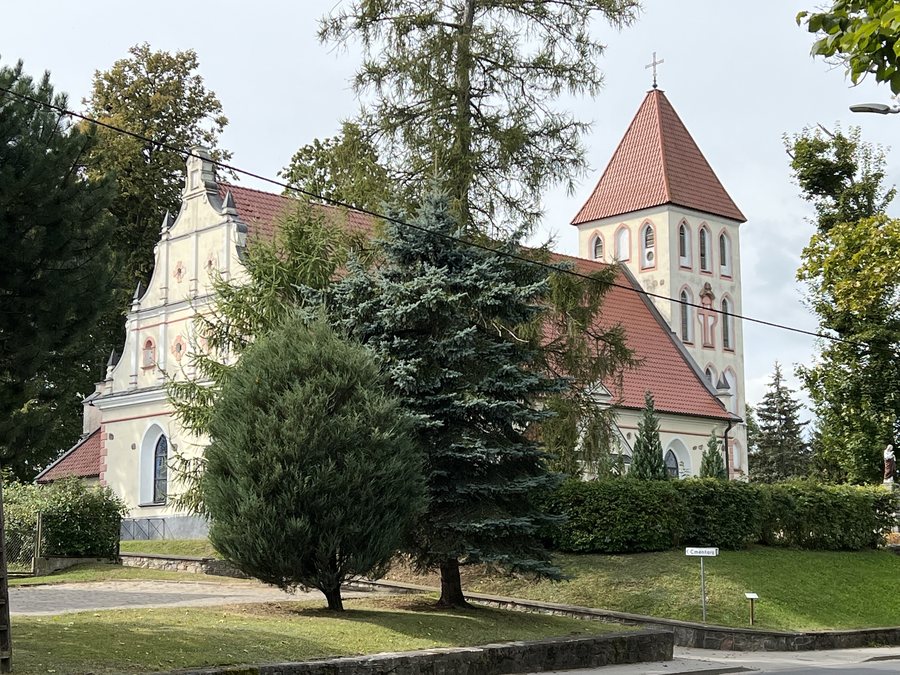 File:Kościół św. Antoniego Padewskiego w Baniach Mazurskich 1.jpg
Photo: Lesnydzban via Wikimedia Commons, CC BY-SA 4.0
The Gołdapa Valley as a landscape landmark
Along almost the entire stretch of the river to Banie Mazurskie, the Gołdapa Valley is narrow and covered with deciduous trees. Banie Mazurskie lies at kilometre 52 of the Gołdapa river route described here. This information locates the village along the course of the river and can help you find your bearings on a map. The valley’s shape and deciduous trees are the specific features that define its landscape.
When planning your trip, you can consider this natural setting alongside the places of cultural and historical interest. The valley offers a landscape landmark, while the churches and monument tell of religious and historical changes. This makes it possible to view Banie Mazurskie through a range of interests, without reducing its local history to a single building or its landscape to the river alone.
Churches with different historical identities
The Church of Saint Anthony of Padua was originally Protestant and is now a Roman Catholic church. The building dates from the 16th century and was renovated in 1876. These two dates represent different chapters in its history: the 16th century marks the building’s origins, while 1876 marks its renovation. Together with its present-day status as a Roman Catholic church, they give a specific picture of its religious history, which spans more than one era.
Another church in Banie Mazurskie was formerly a Baptist church and now serves as a church of a Byzantine-Ukrainian community. If you’re interested in local history and religious buildings, you can consider these two historical strands as separate topics when planning your trip.
A monument in a changed form
The remains of a monument to those who fell in the First World War are another distinctive point of historical interest. A figure of Christ stands on these remains. After 1945, the commemorative plaque, iron cross and top row of granite paving stones were removed from the monument. The present-day description therefore includes both the figure of Christ and the changes made to the monument after 1945. It makes clear that what remains is a relic, not the monument in its unchanged original form. For visitors interested in memorial culture, this site offers a particular perspective on 20th-century history.
A dated cultural event
On Saturday, 24 August 2024, the 13th Festival Barwy Kultury Ukraińskiej took place on the stage and in the GOKiP complex in Banie Mazurskie. The date, edition and venues describe this specific event. The festival adds a precisely dated cultural occasion to the themes that have long shaped the village. It is therefore another distinct element in understanding Banie Mazurskie, alongside the river valley, churches and monument: it points to a Ukrainian cultural festival held at the named venues on that Saturday in 2024.
Which focus suits your trip?
If you’ve chosen Banie Mazurskie as your destination, you can search specifically for a hotel or other accommodation in the village.
Other places at the same level of navigation: Pietrasze, Lisy, Wilkasy, Dunajek, Gołubie, Gołdap, Dubeninki and Klewiny.
For the broader travel overview: Goldap.

