
Krutyński Piecek on the Krutynia
Accommodation in Krutyński Piecek
If you want to plan your trip around a river landscape and a possible kayaking trip, the Krutynia provides a specific point of reference when choosing Krutyński Piecek: the river runs through the village, and kayaking trips are organized on it. Nearby, the Zielony Lasek mill site adds a historical point of interest. The river and the mill offer two distinct focuses for exploring the area—movement on the water and the history of a production building.
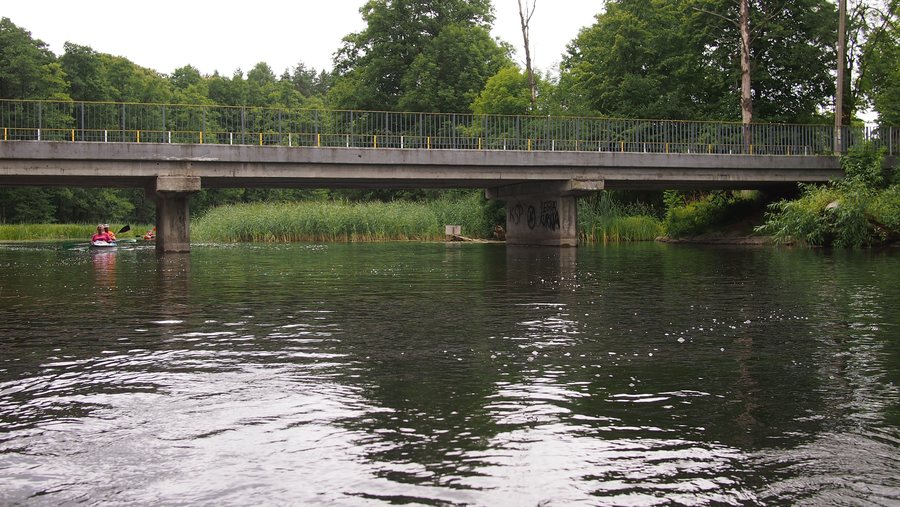 File:Gmina Piecki, Poland - panoramio (222).jpg
Photo: t.przechlewski via Wikimedia Commons, CC BY 3.0
Kayaking on the Krutynia
The Krutynia is the central topic for anyone thinking about a kayaking trip when planning their journey. It is important to distinguish between the river in the village and the specific conditions on a particular stretch: the information about the weir and the portage point refers to the area around the Zielony Lasek mill, not to the Krutynia as a whole.
Below the weir, the Krutynia flows quickly near the mill and is shallow; the riverbed there is stony. Local conditions may vary, however. This information therefore provides a guide to the stretch in question, not to every part of the river. If you are considering a trip, you can keep these differences in mind when planning and check local conditions before setting out.
Portaging at Zielony Lasek
At the mill, kayakers have to carry their kayaks around it to continue toward Rosocha. Near the mill site, the portage is about 70 metres long and runs along the right-hand side. For trip planning, this is a specific interruption to the river route: as well as paddling, the route described here includes a portage at this point.
This means there are two different considerations for a kayaking trip: the described current and riverbed conditions below the weir, and the necessary change to a land route at the mill. Both relate to the area around Zielony Lasek. If this particular river route is a deciding factor in your travel plans, it is worth considering the mill section and the continuation toward Rosocha together.
The mill as a historical point of interest
Even apart from trip planning, Zielony Lasek offers a specific historical point of interest. The mill’s three-storey production building was constructed around 1890. The complex described included two pairs of millstones and a vertical transport system for grain and milled products. This information shows that it was a production building with several levels and different stages of work—a different way of exploring the area than viewing the Krutynia from the water.
The mill site thus complements the history of the river with an architectural and technical perspective. The historical context has a specific timeframe: Zielony Lasek was part of Krutyński Piecek until 2023. Anyone interested in the history of the area can consider this connection alongside the present-day focus on the Krutynia, without treating the two as one and the same.
Which focus suits your trip?
When choosing a destination, you can first ask whether you want to focus mainly on a kayaking trip or on the historic mill site. The river information is particularly relevant to planning the stretch near Zielony Lasek, while the building details provide a point of reference in terms of history and technology. Together, they give a specific picture of the themes associated with Krutyński Piecek, without presuming any particular accommodation or amenities.
If you are considering Krutyński Piecek as a starting point for your search, you can weigh these interests when choosing where to stay: is the river route described here essential to you, or would you also like to include the history of the mill in your travel plans? These two focuses can help guide your search for suitable accommodation during your stay.
Discover more destinations: Kosewo, Użranki, Mikolajki, Maradki, Górkło, Zełwągi, Nowy Zyzdrój, Sądry.
See the main travel overview: Mrągowski.

