
Discover Nowe Miasto Lubawskie
Accommodation in Nowe Miasto Lubawskie
Nowe Miasto Lubawskie combines the landscape of the Drwęca Valley with an easy-to-read medieval urban history. The town lies in the valley of the meandering Drwęca River. Visitors looking to combine nature experiences and historic buildings on their trip will find a range of options here: paths through the valley sit alongside preserved fragments of the town fortifications, a historic parish church and a museum dedicated to regional history.
 Ruins of the Reformed monastery in Łąki Miejskie, Nowe Miasto Lubawskie
Photo: GringoPL via Wikimedia Commons, CC BY-SA 3.0
The Drwęca Valley and routes for active days
The eastern part of Nowe Miasto Lubawskie lies within the Obszar Chronionego Krajobrazu Doliny Dolnej Drwęcy protected landscape area. The Camino de Santiago pilgrimage route also passes through the town. Its route follows the Drwęca Valley and forests, as well as the shores of the lakes of Warmia and Masuria. This makes it possible to include the town in a trip that features nature and longer walks.
For a specific cycling trip, there is a 12.8-kilometre route between Kurzętnik and Nowe Miasto Lubawskie. It runs through the Drwęca Valley, which is protected as part of the Natura 2000 network. Its length helps you decide how to fit the route into your day; no information about journey time or difficulty is provided. A family cycling route starts at the market square, by the tourist information centre there. If you would like to get your bearings before a cycling trip, you can find this centre at Rynek 23.
The surrounding area can also be explored on foot: the 13-kilometre TO-2215 hiking trail connects Nowe Miasto Lubawskie with the yellow trail in the Drwęca Valley.
Town walls, gate towers and church
The surviving fragments of the town wall and the Gothic Brodnicka and Lubawska gate towers are examples of medieval defensive architecture in Nowe Miasto Lubawskie. Construction of the walls began in the 1330s. The urban complex was entered in the register of monuments in 1957. Those interested in historic town layouts can observe different elements of these fortifications in the remaining sections of the wall and the gate structures.
Despite later alterations, the Lubawska Gate Tower retains original loopholes and characteristic bay windows. The Brodnicka Gate Tower has a different role today: since 1959, it has housed the Muzeum Ziemi Lubawskiej. Its collections illustrate the history and everyday life of the region’s inhabitants over several centuries.
Another important building is the parish church, or Basilica of St Thomas the Apostle. Construction began around 1300. Its notable features include a late Renaissance chancel and an organ dating from the early 17th century. For visitors interested in religious architecture and historic furnishings, these details add another building type and period to the picture of the medieval town fortifications.
Market square, cemetery and cultural venues
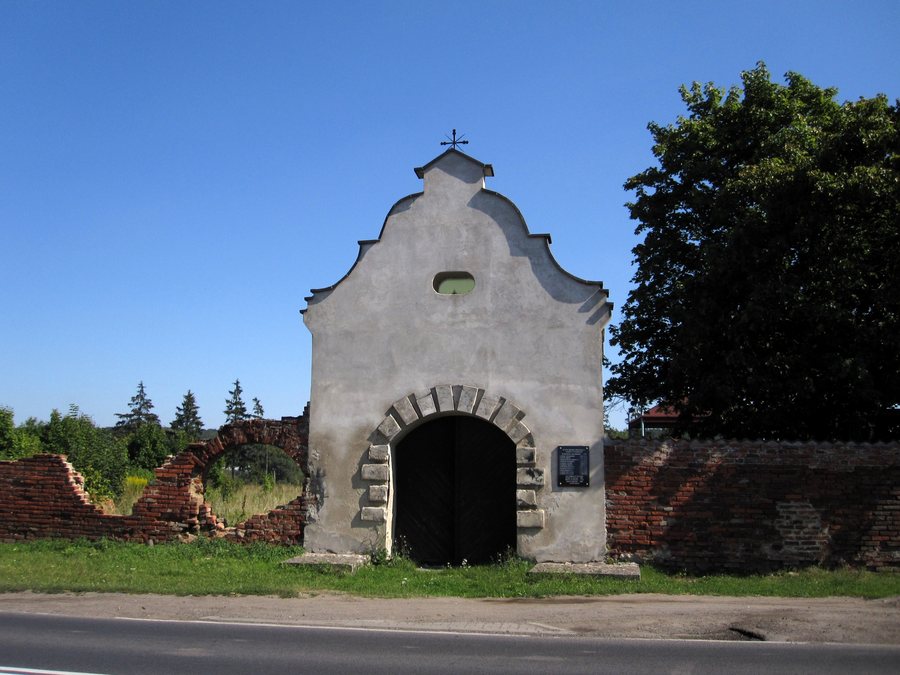
The historic market square preserves the unique character of bygone times and also serves as a landmark for the family cycling route described above. The parish cemetery adds to the picture of historic architecture with its tombstones, a Neoclassical mortuary chapel, adjoining burial chapels and a cemetery gate. These places show that the town’s history can be read not only in its fortifications and church.
For events and culture, the Kinoteatr Harmonia is another point of interest: it has 197 seats and can accommodate up to 300 people for cultural events and concerts. The former Protestant church was used as a cinema in March 2022. As another destination in the wider area, you can consider Pacółtowo.
Explore Nowe Miasto Lubawskie according to your own interests: along paths in the Drwęca Valley, through the remains of the town fortifications, the museum collections or individual historic buildings.
For an overview of the wider trip: Warmia and Masuria.
More destinations
More places within the same destination:

