
Pieszcz: Rural Heritage in West Pomerania
Accommodation in Pieszcz
Pieszcz puts the spotlight on rural heritage in West Pomerania: an unusual village church, traces of a medieval castle complex and evidence of the manor’s history all shape the village’s past. If you choose destinations for their historic architecture and traditional settlement patterns, Pieszcz offers some tangible points of interest.
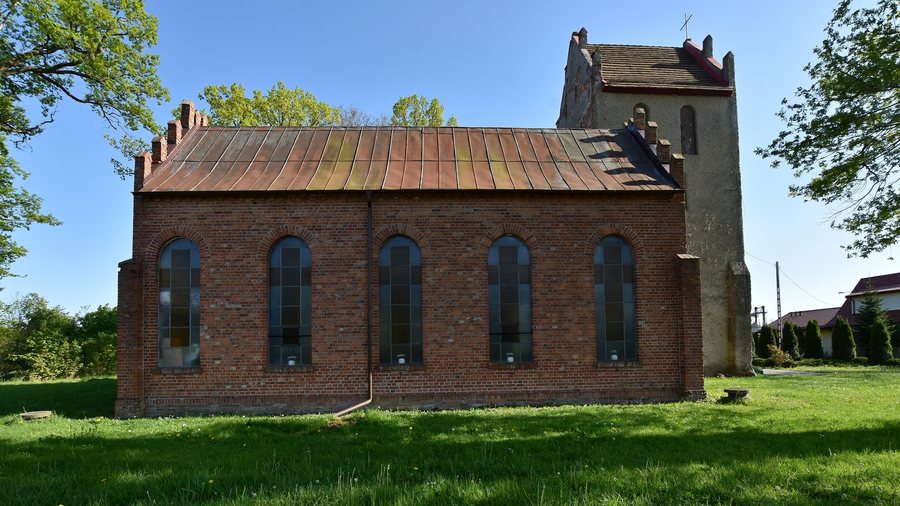 Pieszcz, Church of the Exaltation of the Holy Cross (HB4)
Photo: Henryk Bielamowicz via Source, CC BY-SA 4.0
Village Church with a Distinctive Roof Shape
The church is considered an original example of a rural church in West Pomerania. Unusually, its nave has two aisles; it also has separate roof structures and parallel roof ridges. These architectural features give the church a clearly defined character. When exploring the building, it is worth paying particular attention to how the nave, roof structures and ridges work together, rather than classifying the church simply as a historic building.
Its location in the village is also precisely defined: the church stands in the northeast of Pieszcz, where the main road forks and the road to the former manor begins. The church’s history includes several patrons. It was initially looked after by the Below family; from the 17th century, the von Krockow family also became patrons. The distinctive building thus reflects the development of local patronage, without assigning both families to the same period.
Manor History and Earlier Settlement Patterns
The history of the Pieszcz A manor can be read in various surviving features. Its palace was demolished in the mid-1990s; only the ruins of the manor’s farm buildings remain. The manor complex with Park “A” is part of Pieszcz’s heritage. The medieval castle complex of the Below family has not survived intact either: a mound and moat are reminders of it. These traces represent different periods in the village’s history and should not be conflated as a single structure.
Another tangible trace of the manor era is the 19th-century smithy. It was entered in the regional register of historic monuments on August 1, 1989, under number A-300. This adds another architectural theme to the church: the craft and economic aspects of rural history. Visitors interested in the development of historic settlements can consider these different traces as distinct aspects of Pieszcz.
Parks and Village Layout
The former palace park dates from the 19th century and covers 1.5 hectares. The manor park “B” is also part of Pieszcz’s heritage. The names should not be confused: the date and area are specified for the former palace park, while manor park “B” is listed as part of the heritage.
Pieszcz’s historic village layout can still be made out. There is also a former cemetery on the road to Pałowo, where mature trees remain. Together, these features offer different perspectives on the village: its settlement pattern, the history of its manors and the traces of earlier uses that still remain. Pieszcz is therefore a suitable destination for visitors who want to explore village history and rural architecture in particular.
Other village pages in the same directory: Stary Jarosław, Dabki K Koszalina, Żukowo, Gleznowo, Staniewice, Dąbki, Wicie and Kopań.
For the broader travel overview: Sławno.

