
Mönsterås and Timmernabben: Harbour, beach and history
Mönsterås and Timmernabben connect the coast of the Kalmar Strait with harbour life, local history and easy access to nature. In Mönsterås, the harbour and the circular trail around the Kronobäck wetland are highlights; Timmernabben adds a bathing spot, maritime history and a long-standing ceramics tradition to your visit.
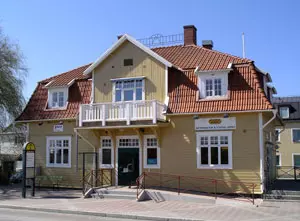 Der Bahnhof von Mönsterås
Photo: © Nils Oberg / Wikipedia
Mönsterås and Timmernabben at a glance
- Location: Both towns are on the Baltic coast in Kalmar County, on the Kalmar Strait opposite Öland.
- Mönsterås: The harbour brings together sports and cultural activities; the trail around the Kronobäck wetland is about 2.4 kilometres long.
- Timmernabben: In Gamla stugbyn, a bathing jetty and a small sandy beach provide access to the water.
- Local history: A maritime history exhibition room and sites connected with the ceramics tradition bring Timmernabben’s past to life.
- Getting around: Bus 163 connects Mönsterås and Timmernabben; the Klosterruinen stop is on the circular trail near Kronobäck.
Harbour and activities in Mönsterås
Mönsterås harbour is a good starting point for an active visit to the town. Aktivitetsparken has areas for parkour, skateboarding, inline skating and BMX. The facilities are open for public use between 8 am and 10 pm, provided they are not being used by clubs or schools. You can combine a visit to the park with a walk along the harbour, fitting it into your day depending on availability. A stage complements the sports facilities with space for music, dance and performances.
If you’d like to explore local history, Mönsterås hembygdsgård has historic buildings and collections. Tours can be arranged by phone or email and last about two hours. They offer an informative introduction to local history. For a self-guided visit, you can combine the walk with Mönsterås Church and Modéerska huset, a heritage-listed merchant’s house dating from the 18th century. During the summer months, the local handicrafts association presents exhibitions and works from the community there.
Kronobäck: wetland and monastery ruins
A circular trail of about 2.4 kilometres starts at Kronobäck Monastery and loops around the wetland. The monastery ruins provide a historic starting point, while the trail makes this a nature stop for half a day out. Kalmar Länstrafik bus 163 connects Mönsterås with Timmernabben and stops at Klosterruinen, close to the trail. This makes it easy to reach Kronobäck from Mönsterås and then continue to Timmernabben on the same bus. By car, Kronobäck is five minutes from the E22. Find the current timetable for route 163 in the Kalmar Länstrafik timetable. The roughly 2.4-kilometre loop makes for a brief scenic stop alongside the coast and town life.
The combination of harbour, historic buildings and wetland gives Mönsterås its character more than any single sightseeing route. Choose your focus according to the weather and your interests: activities at the harbour, a guided tour of the collections or a walk at Kronobäck. For another stop along the Kalmar Strait, consider Oskarshamn, a distinctive coastal and harbour town north of Mönsterås.
Timmernabben: bathing spot and maritime history
In Gamla stugbyn, there is a bathing spot with a jetty and a small sandy beach. Timmernabben is well suited to spending time by the water, combined with a stroll through town. The local sailing club’s boat harbour lies beside the old ferry landing, bringing the area’s maritime history into view. The bathing spot and harbour are two distinct stops on a leisurely walk around town.
The Sjöhistoriska rummet (Maritime History Room) is housed in Korsvirkeshuset. The exhibition tells the story of seafarers and their families around the turn of the 20th century, focusing on everyday life and shipping. Another local tradition is fish smoking at Nabbens Rökeri & Fisk: the business has used traditional artisanal methods at the same location since the early 1950s. In summer, Strandfiket at Danska Varvet beach adds homemade pastries to your coastal visit.
Ceramics tradition and townscape
Timmernabben is also part of Sweden’s faience and ceramics history. Tillinge Fayence & Terracotta Fabrique began producing earthenware here in 1859. Since 2021, Gabriel Keramik’s premises have been devoted exclusively to making tiled stoves; a windmill is also part of the townscape. You can split your visit into two parts: first, the bathing spot and harbour, followed by the buildings and sites that tell the story of local production.
Kalmar lies to the south, Oskarshamn to the north along the coast, and Öland is just across the bridge. As stops along the coast of the Kalmar Strait, both towns fit into a route between these destinations; Blekinge and Småland make up the wider region. An overnight stay in Mönsterås makes a good base for the harbour and Kronobäck Monastery; accommodation in Timmernabben is well placed for the bathing spot, harbour and ceramics sites.
Frequently asked questions about Mönsterås and Timmernabben
What can I combine in Mönsterås during a half-day visit?
A compact route takes you from the harbour and Aktivitetsparken to the town centre and then on to Kronobäck Monastery. Allow about two hours for a guided tour of the hembygdsgård, so it works best as a separate focus for your day.
Where is the bathing spot in Timmernabben?
The bathing spot is in Gamla stugbyn. A bathing jetty and small sandy beach lead down to the water; the harbour and old ferry landing make good additions to a walk through this coastal town.
How does Timmernabben differ from Mönsterås?
Timmernabben brings together a beach, harbour and ceramics history in a compact area. Mönsterås offers places to visit between the harbour, town centre and wetland, including Aktivitetsparken, historic collections and the Kronobäck circular trail.
