
The Island of Öland
The island of Öland, located in the Baltic Sea off Sweden’s east coast, is one of Sweden’s most popular holiday destinations. It is particularly well known for its many hours of sunshine, much like several other Baltic Sea islands. Öland has been connected to the Swedish mainland near Kalmar by a bridge only since 1974. When completed, at six kilometres long, it was the longest bridge in Europe. It spans the Kalmar Strait, the waterway just a few kilometres wide between Öland and the mainland.
With its dimensions—137 kilometres long and up to 16 kilometres wide—Öland is a geographical and geological phenomenon. Limestone, sandstone and shale dominate the island’s surface. The southern half of the island, known as Stora Alvaret, is a karst and heathland landscape and part of a World Heritage Site. It is also home to the reconstructed prehistoric fortress of Eketorp, where the daily life of the island’s early inhabitants has been recreated. The earliest traces of settlement on Öland are estimated to be about 7,000 years old. A stone wall from the Middle Ages, almost completely intact, runs across the island’s southern tip; it was intended to “enclose” game in what was then the royal hunting grounds.
Among Öland’s best-known sights are the Borgholm Castle ruins in the north and nearby Solliden Palace, one of the Swedish royal family’s summer residences. Both attract hundreds of thousands of holidaymakers every year. Most visitors to Öland make their first stop at the island’s WelcomeCenter in Färjestaden, beside the Öland Bridge’s connection to the island. Here, visitors can find all the essential information about the island. The adjacent playground and wildlife park also make an ideal destination for a family holiday on Öland.
The lighthouses at the island’s northern and southern tips, Långe Erik and Långe Jan, are considered landmarks of Öland. Both towers offer fascinating panoramic views of the island and the busy shipping lanes around Öland. Near the southern tip lies the Ottenby bird sanctuary, while in the north, the “Troll Forest” has been developed as the Böda Ecopark. The granite island of Blå Jungfrun, a national park, lies between the northern coast and the mainland.
Öland is an exceptionally varied holiday destination in Sweden, with a wide range of holiday homes and campsites. It is also a popular day-trip destination for visitors from the Swedish mainland.
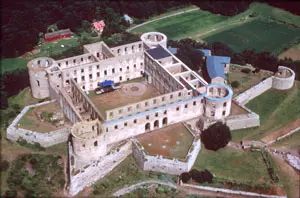 Burgruine Borgholm auf Öland
Photo: © Ölands Turist AB/olandsturist.se
Burgruine Borgholm auf Öland
Photo: © Ölands Turist AB/olandsturist.se
