
Bornholm, Denmark
The Danish Baltic island of Bornholm is unique in many ways. At 150 kilometres, it is farther from its mainland country, Denmark than it is from Sweden (37 km), Germany (88 km) and Poland. In a very small area, visitors can experience almost the entire spectrum of Scandinavian nature. The dune landscape of Dueodde in the southeast finds its counterpart in the rocky cliffs in the north of Bornholm. At the heart of the island, which covers just 588 square kilometres, lies Almindingen forest, Denmark’s third-largest forest. At 162 metres, it is also home to one of Denmark’s highest “mountains”, Rytterknægten.
The European boundary between two geological formations of different ages runs right through Bornholm, with the northern formation also shaping the Scandinavian bedrock massif. Its most striking features are the rocky coastline and the northern tip, with Hammershus, the largest castle ruin in Northern Europe. It is also a reminder of the island’s exceptionally eventful history, shaped by the Baltic powers Denmark and Sweden.
The main town of Rønne has one of the largest ferry ports on the Baltic Sea, with connections to Denmark, Sweden, Germany and Poland. Scheduled flights from the airport serve Denmark, Germany, Norway and Sweden. Like something straight out of a picture book, small harbours line the island of Bornholm’s rugged outer coast.
Bornholm is addictive—that is the simplest way to sum up the fascination of this Danish Baltic island. Seven out of ten first-time visitors return to Bornholm. The island’s healthy, invigorating climate, characteristic of all the Baltic islands, is one reason why.
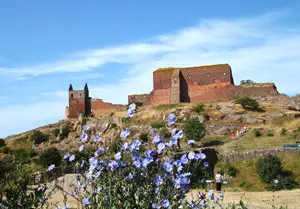 Burgruine Hammershus auf der Insel Bornholm
Photo: © Destination Bornholm
Burgruine Hammershus auf der Insel Bornholm
Photo: © Destination Bornholm
