
Narva: Fortress, Town Hall and Baltic Sea Beach
Narva lies in northeastern Estonia on the Narva River, which forms the border with Russia here. The city combines a striking fortress landscape with its Baroque town hall and the nearby Baltic Sea beach at Narva-Jõesuu.
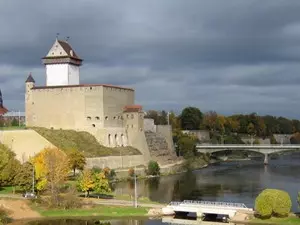 Die Hermannsfeste
Photo: © oben: Lisa Schwalb / Wikipedia.de_CC3.0, Rathaus: © Anatra1987 / Wikipedia.de_gemeinfrei, unten: Geonarva / Wikipedia.de_CC3.0
Narva at a glance
- Narva lies on the Narva River in Ida-Viru County in northeastern Estonia.
- On the opposite riverbank stands Ivangorod Fortress, while Narva Castle dominates the Estonian side.
- The castle complex covers 3.2 hectares, and the Tall Hermann Tower stands 51 metres high.
- The town hall dates from the 17th century and reopened in 2023 after restoration work.
- The Baltic Sea beach at Narva-Jõesuu lies around twelve kilometres north of the city.
- The beach stretches for 7.5 kilometres along the southern shore of the Gulf of Finland.
Getting to Narva
From Tallinn, you can reach Narva by Elron train from Balti Jaam or by long-distance bus. Both routes take you directly into the city and make a convenient starting point for visiting the castle, town hall and riverside promenade. If you are continuing on to the Baltic Sea beach, take local GoBus 31 to Narva-Jõesuu.
Narva Fortress: history on the border river
The medieval castle rises on the western bank of the border river, directly opposite the Russian fortress of Ivangorod. The Danes established the castle in the 13th century as the seat of their royal governor. Its present-day appearance took shape between the 14th and 16th centuries under the Livonian Order. At 51 metres high, Tall Hermann is the complex’s distinctive observation tower. Exhibitions at the museum trace the history of Narva and the castle, while craft activities take place in the Northern Courtyard. This allows visitors to focus either on the architecture or on everyday life in earlier centuries.
The riverside location explains Narva’s distinctive cityscape: from the castle, the river and Ivangorod Fortress are directly in view. The area’s shifting rulers are reflected in its architectural history. In Estonia, other coastal towns and island destinations make a trip to Narva even more rewarding.
Town hall and city centre
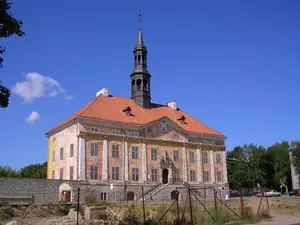 The town hall on Town Hall Square is a rare surviving historic building in a city centre that was rebuilt in a very different form after extensive destruction during the Second World War. The 17th-century building combines German, Swedish and Italian architectural influences. Following a comprehensive restoration, the town hall reopened in June 2023. The building also houses the tourist information centre; guided tours and a virtual reconstruction of the former city centre offer additional perspectives on Narva’s history.
The riverside promenade connects the city centre with the riverbank and the fortress landscape. The castle, town hall and promenade can be combined in a single city walk. Admission is required for the castle museum, which is open Wednesday to Saturday from 10 am to 6 pm and Sunday from 10 am to 4 pm; it is closed on Mondays and Tuesdays. Ticket sales end one hour before closing. As a suggested itinerary, spend two to three hours in the morning at the castle museum and tower, then visit Town Hall Square and the riverside promenade. If you arrive on a Monday or Tuesday, explore the town hall and riverfront; plan the castle museum for a day when it is open.
Beach and pine forest in Narva-Jõesuu
Narva-Jõesuu lies around twelve kilometres north of Narva on the Gulf of Finland. The 7.5-kilometre sandy beach is bordered by pine forest and combines swimming areas with a natural coastal landscape. GoBus 31 runs between Narva and the coastal town, serving stops including Sauna, Apteegi, Meresuu and Lydia Koidula in Narva-Jõesuu. This makes it easy to plan a beach trip using local public transport. For a full day out, visit the castle, town hall and riverside promenade in the morning, then head to Narva-Jõesuu for time at the beach, in the pine forest and in the swimming area. If you would like more time at the beach, Narva-Jõesuu also works well as a separate day trip. Beach facilities include a supervised swimming area, a beach volleyball court, a children’s playground, changing cabins and showers. Discover more cities and destinations in northeastern Estonia via Rakvere and the Estonian capital, Tallinn.
Frequently asked questions about Narva
How far is Narva-Jõesuu from Narva?
The beach town lies around twelve kilometres north of Narva. GoBus 31 connects Narva with Narva-Jõesuu and serves stops there including Sauna, Apteegi, Meresuu and Lydia Koidula. You can include the local bus journey to the coast in your day’s plans; the best stop for the beach depends on which section you want to visit. One option is to see the castle, town hall and promenade in the morning, then spend the afternoon at the beach. A dedicated beach day leaves more time to enjoy the coast and pine forest.
What is the main attraction in Narva?
The castle houses the Narva Museum, with a permanent exhibition on the history of the city and castle. It is open Wednesday to Saturday from 10 am to 6 pm and Sunday from 10 am to 4 pm; it is closed on Mondays and Tuesdays. Ticket sales end one hour before closing. Standard admission costs €16, while a family ticket for two adults and their underage children costs €32. The tower and river views round out the visit.
What does the beach at Narva-Jõesuu offer?
The 7.5-kilometre sandy beach lies on the southern shore of the Gulf of Finland and is bordered by pine forest. Facilities include a supervised swimming area, a playground, changing cabins and showers.
Hotels in Narva provide a convenient base for visiting the castle, town hall and riverside promenade.
