
Gothenburg
Sweden’s second-largest city was founded in 1619 at the behest of King Gustav II Adolf, at the mouth of the Göta Älv. It stood on the only narrow strip of the west coast under Swedish control, since Bohuslän belonged to Norway and Halland to Denmark until 1658.
The city was shaped by Dutch and German architects. Trade, closely tied to the English, was largely conducted with East India. The Östindiska Huset in the city centre bears witness to these traditions to this day and has been converted into a city museum.
At the end of the canal system built by the Dutch lies Gustav Adolfs Torg, the heart of old Gothenburg. The Town Hall and the Stock Exchange flank the statue of the city’s founder.
Two attractions draw the city’s many visitors: the opera house, one of the most architecturally beautiful music theatres, and “Utkik”, an office tower offering views over the city from a height of 86 metres. Directly below the opera house, Packhuskajen is home to a maritime museum showcasing a collection of historic ship types.
Alongside the city’s largest church to this day, Christina Church (also known as the German Church), two other churches are among the main attractions for visitors. From Masthugg Church, the view stretches across the entire city, from the centre to the broad western outlet and the industrialised northern shore of the Göta Älv. By contrast, “Feskekörkan” only looks like a church from the outside: the city’s famous fish market has never been a place of worship.
Gothenburg lies amid the captivating archipelago of Sweden’s west coast, with its many holiday homes and mostly small hotels. It is unquestionably the main tourist hub of Sweden’s west coast, a region shaped above all by its maritime character, serving both as a destination for day trips and as a base for shopping and strolling through a historic yet modern city centre. Several small marinas at the mouth of the Göta Älv are as much a feature of the cityscape as the large ferry port, with connections to Frederikshavn (Denmark) and Kiel.
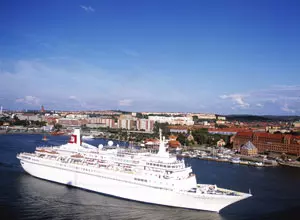 Fähre in Göteborg
Photo: © Kjell Holmner / Göteborg & Co IMAGEBANK
Fähre in Göteborg
Photo: © Kjell Holmner / Göteborg & Co IMAGEBANK
