
Gothenburg & Bohuslän, Sweden
The second-largest Swedish city, Gothenburg , a metropolis on Sweden’s west coast, lies at the same latitude as the northern tip of the Baltic Sea near the Danish town of Skagen. Founded as late as 1619 by King Gustav II Adolf of Sweden as a counterweight to Stockholm , Gothenburg today serves as Sweden’s gateway to the west. Its architecture, industry and population structure also give it a more Western European character. Gothenburg lies in the region of Bohuslän, which stretches north from the city. On the Göta älv River, which connects Sweden’s largest lake, Lake Vänern, with the port city of Gothenburg, the ruins of Bohus Fortress are clearly visible north of the city.
Bohuslän is one of Sweden’s most popular holiday regions. Its unique coastline is characterized by countless bare rocky islands, known as skerries, numerous bays, small hidden resorts, former fishing villages, narrow beaches and a wooded hinterland.
Several small and medium-sized ports, such as Marstrand, Lysekil, Hunnebostrand, Grebbestad, Fjällbacka and Strömstad , are starting points for memorable trips by private boat or small excursion vessel into the skerries of Bohuslän. In 2009, “Kosterhavet,” the sea area around the Koster Islands, became Sweden’s first marine national park. Smögen is uniquely situated, nestled right among the rocky cliffs. Not far from the coast near Tanumshede are prehistoric rock carvings, which are of special significance as part of a World Heritage Site.
From luxury hotels in Gothenburg and small hotels in stylish Marstrand to countless holiday homes and campsites along the entire coast, every visitor can find accommodation to suit their needs. The busy marinas between Gothenburg’s outer districts and Strömstad on the Norwegian border are further testament to the appeal of Bohuslän, this unique holiday region on the Baltic coast and close to it.
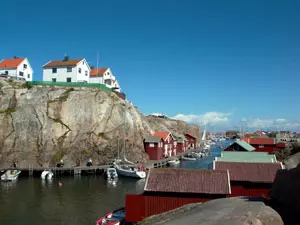 Schärenort in Bohuslän (Schweden)
Photo: © nordlicht verlag
Schärenort in Bohuslän (Schweden)
Photo: © nordlicht verlag
