
Ängelholm: Town History, Beach and River
Ängelholm is located in northwestern Skåne, on the Bay of Skälderviken. The town combines a historic centre on the Rönne River with sandy beaches, dunes and pine forest. This makes it easy to plan a stay that brings together walks by the water, local history and excursions into the Swedish coastal landscape.
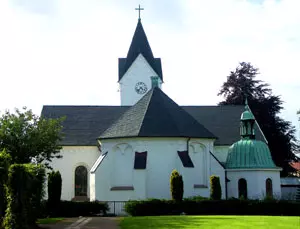 Kirche von Ängelholm
Photo: © David Castor / Wikipedia.de
Ängelholm at a glance
- Location: A town in northwestern Skåne, on the Bay of Skälderviken.
- Townscape: The Rönne River runs through the town; Stortorget and Storgatan define the historic centre.
- History: Kristian II granted Ängelholm its town charter in 1516; at the time, the town belonged to Denmark.
- Coast: The beach at Havsbaden is bordered by dunes and pine forest.
- Nature in town: Riverside paths and Hembygdspark bring green spaces together with local history.
- Base for exploring: Accommodation in Ängelholm is well suited to a stay combining town and coastal excursions.
Town history on the Rönne River
The Rönne River is a great starting point for getting to know Ängelholm. It winds through the town, shaping its paths, bridges and green spaces. The oldest part of the town lay within the river’s distinctive bend. Stortorget and Storgatan still showcase the historic centre, whose layout dates back to the 16th century. A stroll through the town centre can therefore easily be combined with a walk by the water.
King Kristian II granted Ängelholm its town charter in 1516. The town was Danish at the time; Skåne became Swedish only later. Its Danish heritage is part of its history, as is its development into a small craft and industrial town. Locally sourced clay supported the pottery trade: in the 19th century, Ängelholm had an especially large number of pottery workshops. Leatherworking, the sugar industry and, later, the railway also transformed the town. The railway station opened in 1885, connecting Ängelholm more closely to the wider transport network.
The old Kronohäktet, a historic prison building, is one of the town’s surviving reminders of its past. Nearby Hembygdspark offers another way to combine a visit with green space and local culture. Together with the squares and streets in the centre, these places make for a compact walking route that can be explored in stages.
Beach, dunes and pine forest
Havsbaden, with its long sandy beach, lies west of the town centre. Beyond the open beach are dunes and pine forest. This succession of landscapes makes Ängelholm’s coast varied: the view is expansive by the water, while the woodland paths offer shelter and a quieter setting. The coastal plantations were also established to control shifting sand; today, the trees are a defining feature of the Kronoskogen recreation area.
The beach and forest can be combined into a longer walk. If you prefer cycling, the signposted Lergöksrundan route passes through Kronoskogen, along the sea and through the town centre. This lets you combine nature and town life in one day, rather than limiting your plans to a beach visit. The coastal area is particularly well suited to a stay that gives equal importance to swimming, exercise and woodland paths.
The Rönne River also offers a different perspective on the landscape. Green spaces line the river through the town, while beyond the centre it continues through the surrounding countryside. Riverside walks complement a coastal visit with a quieter, town-based perspective. Ängelholm is therefore a good choice of base if you plan to enjoy both the beach and local walking routes, as well as excursions around northwestern Skåne.
Including Ängelholm in a trip around Sweden
Ängelholm makes a good stop if your route is about combining coastal nature with local history. For a longer stay, consider mixing time in the town centre with walks along the river and an excursion to Havsbaden. The selection of accommodation in Ängelholm makes it easier to compare options and find a suitable base for this combination.
If you continue your coastal journey through Skåne, you could add Malmö as a city stop farther south. The metropolis combines an old town and the Öresund coast with a much more urban feel. Farther north, Gothenburg takes you to Sweden’s west coast and its archipelago. On a much longer journey along Sweden’s coastline, Gävle in southern Norrland offers another port-city contrast. Each place makes for a different kind of stop: Ängelholm for beaches and the river, Malmö for city life and the Öresund, Gothenburg for its harbour and islands, and Gävle for the coast of the Gulf of Bothnia.
Frequently asked questions about Ängelholm
Where is Ängelholm?
Ängelholm lies on the northwestern coast of Skåne, on the Bay of Skälderviken. This makes it a coastal destination in southern Sweden, where the beach, river and pine forest shape the experience.
What can you combine during a visit to Ängelholm?
A tour of the town centre and a walk along the Rönne River pair well with a visit to Hembygdspark. If you have more time, add the beach and forest at Havsbaden.
How is Ängelholm different from Malmö?
Ängelholm combines a smaller historic town centre with a sandy beach and pine forest. Malmö offers a big-city experience on the Öresund, with an old town, museums and an urban beach. The two make contrasting stops on a trip through Skåne.
