
Malmö
Sweden’s second-largest city, Malmö (population 260,000), lies on the Øresund, one of the most distinctive points along the entire Baltic coast. Together with the Danish capital Copenhagen on the opposite shore, it controls the most important entrance to the entire southern and eastern Baltic Sea. Since the Øresund Bridge opened in 2000, the Øresund region has become even more closely integrated and is among the most dynamic regions not only around the Baltic Sea, but in all of Europe.
Malmö’s roots go back to the 12th century, when it was still under Danish rule: the entire province of Skåne, whose capital is Malmö, remained part of the Danish state until 1658. Unlike nearby Lund, the seat of a bishop, Malmö was an economic centre from the outset and soon overtook Lund as Skåne’s most important town.
Malmö is especially appealing to its growing number of visitors and tourists because all its major sights are concentrated in a compact area. The city centre is close to the expansive park and Malmöhus, a fortress dating from the 15th century that now houses three museums. The town hall, built in 1546, was the initiative of Mayor Jörgen Kock. St. Peter’s Church was built in the 14th century in the style of North German Brick Gothic. Not far from Stortorget, the main square, Lilla Torg (“Little Square”) has become a lively part of the city, with outdoor dining available in some places year-round.
Just north of the railway station lies the harbour area, including the museum harbour. Two medieval ships are on display here, and the nearby Cog Museum explains the historical background of Hanseatic shipbuilding. Malmö’s new landmark, the 190-metre-high, architecturally “twisted” Turning Torso skyscraper, was built in 2005 on the site of a former shipyard. The entire former maritime industrial area has been transformed into an extensive network of promenades.
Malmö is surrounded by the flatlands of Skåne, a landscape reminiscent of northern Germany. The city has its own beach and several marinas. Its convenient location on the Danish-Swedish north–south route is complemented by Sturup International Airport, although many arriving and departing passengers use Copenhagen Airport, one of Europe’s largest.
Malmö is not only the metropolis of southern Sweden; with its blend of big-city attractions and abundant green spaces, it is also an appealing destination for city breaks and a popular day trip for Baltic Sea holidaymakers staying in the surrounding resort areas, with their many holiday homes and campsites.
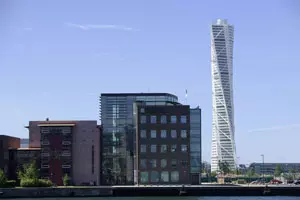 Neues Wahrzeichen Malmös: Turning Torso
Photo: © Business Region Skåne
Neues Wahrzeichen Malmös: Turning Torso
Photo: © Business Region Skåne
