
Rerik between the Baltic Sea, Salzhaff and Wustrow Peninsula
Rerik lies between the Baltic Sea and the Salzhaff lagoon, separated by the narrow Wustrow Peninsula. Instead of an ordinary seaside resort, you’ll find two distinct waterscapes, a fishing harbour, paths along the lagoon and the steep coast, and traces of Slavic and prehistoric settlement.
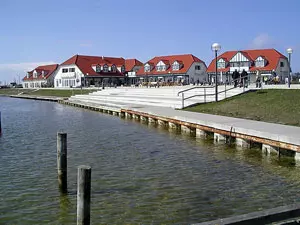 Haffplatz in Rerik
Photo: © Kurverwaltung Rerik
Rerik at a glance
- Rerik lies where the Baltic Sea meets the Salzhaff; the Wustrow Peninsula separates the lagoon from the open sea.
- The pier is closed because it no longer meets structural safety requirements; a new one is planned.
- Haffplatz, the fishing landing and the lagoon landing are close to the town centre, on the Salzhaff.
- Wustrow is closed to individual visitors; excursions along the peninsula are only possible as part of guided walks.
- The local history museum, St John’s Church, Schmiedeberg and the megalithic tombs offer specific cultural and historical sights.
The Baltic coast and Salzhaff: two different landscapes
Rerik lies at the entrance to the Wustrow Peninsula. On one side is the Baltic Sea, with its beach and steep coast; on the other, the Salzhaff opens out, with salt meadows, dunes and bird sanctuaries. These contrasting landscapes shape your stay: along the Baltic shore, natural beach alternates with steep coastal stretches, while from the lagoon shore the view takes in the water, sailing boats and protected areas.
Clear nature-conservation rules apply when walking around the Salzhaff. Keep to designated paths, keep dogs on a lead, and avoid noise and litter; watercraft must not enter the reed beds. The Salzhaff is an important European bird sanctuary where coastal birds breed and feed. The Wustrow Peninsula is also protected and is not open for independent day visits: visitors can only take part in guided walks. If you’d like to experience the coastal landscape from the water, during the main season you can take an approximately two-hour round trip on the Salzhaff, which follows the peninsula’s shoreline.
The pier at the Baltic seaside resort is also currently closed to pedestrians. The municipality closed it because it no longer met structural safety requirements and opted to build a new pier rather than renovate it. Its historic length of 170 metres therefore does not reflect current access. To enjoy views of the beach and Haffplatz, use the shore paths and promenade for now—not the closed pier.
Haffplatz, fishing and a walk around town
Haffplatz is a good starting point for a walk around town. Cafés and small shops line the promenade, followed by a small marina, the fishing landing and the lagoon landing. At the fishing landing, you can get a sense of the working life of a fishing town. The lagoon landing serves as a stop for recreational boaters and welcomes visiting boats in summer; during the main season, excursion boats set off on trips along Wustrow.
From the beach towards Haffplatz, you can extend your walk into the town centre, with its small spa park and children’s playground. For families, this makes for a practical outing combining a beach walk, the harbour area and a break among the greenery, without relying on access to the closed pier or Wustrow. Haffplatz is not just a viewpoint; it is also a convenient link between the beach, places to eat and the landing stages.
History between the church and Schmiedeberg
The early Gothic St John’s Church is one of the town’s oldest buildings. Schmiedeberg brings Slavic history to life with an archaeological trail and information boards; megalithic tombs can also be found nearby. At the local history museum, visitors can learn more about the town’s history and coastal landscape, and see changing exhibitions of regional art. These sights make a good itinerary for a day of changeable weather or a complement to walks along the beach.
Alongside its permanent exhibition, the local history museum has a gallery showing changing exhibitions. A visit adds local history to a coastal walk, while the church and Schmiedeberg help orient you within the town even if you don’t visit the museum.
Rerik as a base on the Bay of Mecklenburg
In Rerik, the focus is on the Salzhaff, fishing and the protected peninsula. On Poel Island, you’ll find seaside villages and a lighthouse; Wismar adds Hanseatic history and a harbour to the region. To the west, Boltenhagen offers a long sandy beach, a pier and steep coastal scenery. When choosing where to stay, consider the location and your plans for the day: the town centre brings Haffplatz, the fishing landing and routes to the beach together, while accommodation outside the centre is better suited to rural paths and coastal access points. You can compare accommodation in Rerik accordingly.
Frequently asked questions about Rerik
Can I walk onto the pier at the moment?
No. The municipality has closed the pier because it no longer meets structural safety requirements and is planning a new one. For a walk by the water, the beach, Haffplatz and the shore paths are available.
Is the Wustrow Peninsula accessible?
Independent visits are not possible. The peninsula can be visited as part of a guided walk; alternatively, a seasonal boat trip offers views of the coast from the Salzhaff.
How does the Salzhaff differ from the Baltic Sea?
Wustrow separates the lagoon from the open Baltic Sea, and the Salzhaff is characterised by salt meadows, reeds and bird sanctuaries. Along the Baltic beach, you’ll find waves and stretches of steep coast; the lagoon offers calmer waters and harbour views.
