
Wismar: World Heritage Old Town and Old Harbor
Wismar brings together a medieval town center and a harbor that is still bustling today. A walking tour leads from the market square, with its Wasserkunst and “Alter Schwede,” through the brick-lined streets to the Old Harbor; churches, the museum, and the harbor each tell a different part of the Hanseatic story.
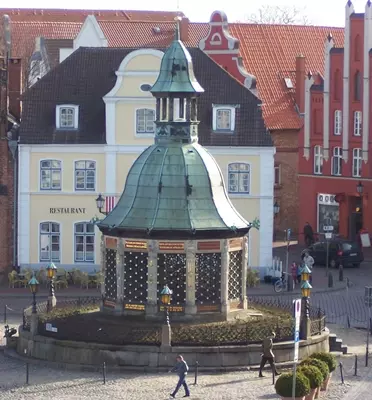 Marktplatz von Wismar
Photo: © hauku / pixelio.de
Wismar at a glance
- The historic old towns of Wismar and Stralsund have jointly been a UNESCO World Heritage Site since 2002.
- The surviving town plan reveals the streets, squares, and quarters of a prosperous 14th-century Hanseatic city.
- The market square is home to the Town Hall, the Wasserkunst, and the burghers’ house known as “Alter Schwede.”
- The Old Harbor brings together passenger ships, fishing boats, and historic vessels, with views of the brick-built old town.
- The SCHABBELL City History Museum and the brick churches offer cultural attractions for a rainy day or a longer visit.
From the Market Square through the Brick-Built Town
The market square is a good starting point for your first walking tour. The Wasserkunst at its center served as the town’s drinking-water supply until 1897 and was built between 1579 and 1602 in the Dutch Renaissance style. On the east side stands the late Gothic burghers’ house “Alter Schwede,” whose name recalls Swedish rule but did not come into use until the 19th century. The Town Hall and the gabled houses together define the historic square.
From there, narrow streets lead to St. Mary’s Church Square and the Grube. The Grube is a surviving medieval watercourse that flows through the old town toward the harbor. The brick basilica of St. Nicholas and St. George’s Church showcase religious architecture on different scales, while the surviving tower of St. Mary’s recalls the former grandeur of the brick church. A walk past the churches, the Fürstenhof, and the Water Gate takes you through real parts of the World Heritage old town, not just past façades.
UNESCO status applies to Wismar’s historic old town and its largely intact medieval layout. It does not automatically cover every district or the entire area of the modern city. The 2002 UNESCO inscription refers to the historic old towns of Wismar and Stralsund jointly; the street, square, and neighborhood layout, along with the Old Harbor, are among their defining features.
The Harbor, the Grube, and the Swedish Era
At the Old Harbor, maritime life today meets historic warehouses. Passenger ships, fishing boats selling their catch, historic vessels, and recreational boats line the quay; the harbor has places to eat and offers sweeping views back toward the old town. The Baumhaus and the Swedish Heads recall the period of Swedish rule. Start or end your walk here, and you’ll experience Wismar not just as an open-air museum but as a working harbor town, too.
For a deeper museum visit, head to the SCHABBELL, Wismar’s city history museum. It complements the historic buildings with stories of the town, its trade connections, and life in its old houses. At the Old Harbor, it’s also worth looking out for the Grube, described as the last surviving purpose-built medieval watercourse of its kind in a northern German old town. The route linking the market, the streets, the watercourse, and the harbor offers an easy-to-follow journey through the town’s historic trading center.
Planning a Day Out and Choosing a Base
For a first day, try the route from the market square to the Wasserkunst, Alter Schwede, St. Mary’s Church Square, and the Old Harbor. If you’d like to add a museum, make the SCHABBELL a stop of its own; on another day, you can visit individual churches, the World Heritage House, or take a guided tour. That way, you can spread out the outdoor sights and indoor visits instead of cramming everything into one overly long walk around town.
Wismar lies on Wismar Bay and makes a convenient base for exploring the town and Poel Island, where beaches, harbor villages, and the island church complement the city’s Hanseatic history. To the west is Boltenhagen, with its sandy beach, pier, and cliffs; to the east, Rerik offers a contrast between the Baltic Sea and the Salzhaff lagoon. If you’re combining a museum-and-city day with time at the beach, the nearby coastal destination of Zierow on Wismar Bay is a good alternative for accommodation.
Frequently Asked Questions About Wismar
What is included in Wismar’s UNESCO World Heritage Site?
The World Heritage Site includes the historic old town and its medieval layout, with its streets, squares, neighborhoods, and the Old Harbor. The protected area does not represent the entire area of the modern city.
Which attractions are located on the market square?
The Town Hall, the Wasserkunst, and the burghers’ house “Alter Schwede” define the square. From there, St. Mary’s Church Square, the Grube, and the Old Harbor are all within walking distance.
How is Wismar different from a seaside resort?
Wismar is a historic Hanseatic city with an old town, churches, a museum, and a commercial harbor. For a beach or swimming break, add a separate destination on Wismar Bay, such as Poel or Zierow, to your city visit.
