
Aarhus
As Denmark’s second-largest city with around 270,000 inhabitants, Aarhus is not only the metropolis of Jutland. The city is considered the western “counterpart” to the capital, Copenhagen, in western Denmark. Aarhus Cathedral is the longest and tallest church in all of Denmark. The city did not achieve its prominent economic and political position until after the loss of Schleswig and Holstein in 1864 and its connection to the Danish railway network.
The open-air museum “Den Gamle By,” a town within a town, is Aarhus’s best-known landmark and a popular destination for visitors. Since 1914, historic buildings—first from Aarhus and later from all over Denmark—have been faithfully reconstructed here in the style of a medieval town. Many of these houses are open to the public and contain workshops or exhibitions. The Town Hall’s distinctive design, with its 60-metre-high tower and exterior vertical stone ribs, is now recognized as a landmark of functional Danish modernism.
Aarhus is an exceptionally cycle-friendly city. In many places, bicycles can be borrowed against a deposit, used for as long as you like and returned. This also offers a great opportunity to “ride around” and discover the city’s sights: the children’s amusement park “Tivoli-Friheden,” as well as the prehistoric Moesgaard Museum south of the city, home to the world’s best-preserved bog body. The building of the Aarhus Art Museum, which opened in 2004, is an attraction in its own right, with its spiral ramp reminiscent of New York’s Guggenheim Museum.
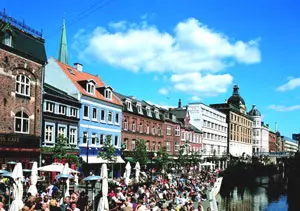 Århus in Ostjütland
Photo: © Morten Jac/VisitDenmark
Århus in Ostjütland
Photo: © Morten Jac/VisitDenmark
Several beaches north and south of the city invite visitors to swim in Aarhus Bay.
