
Saltsjöbaden near Stockholm
Saltsjöbaden lies on Baggensfjärden, southeast of Stockholm, and combines an archipelago coastline with the history of a planned seaside resort and villa town. The Grand Hotel, historic villas, two cold-bath houses, a church and an observatory provide several distinct stops on a walk through the area.
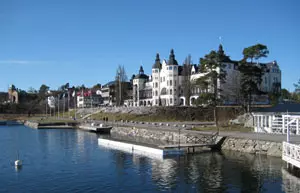 Grand Hotel in Saltsjöbaden
Photo: © Marcus Bernet / Wikipedia
Saltsjöbaden at a glance
- Location: Saltsjöbaden is in Nacka Municipality, on Baggensfjärden at the edge of the Stockholm archipelago.
- Origins: Its development as a seaside resort and villa town began in the 1890s, at the initiative of banker Knut A. Wallenberg.
- Railway history: The Saltsjöbanan railway established the first overland connection between the town and Stockholm in 1893.
- Townscape: Villas from several building periods stand alongside the Grand Hotel and prominent public buildings.
- Walking tour: Nacka Municipality describes a cultural walking tour of about two kilometres, with nine stops.
- Highlights: Architecture, bathing history, railways and science come together at specific sites.
From seaside resort to villa town
Saltsjöbaden was planned in the 1890s as a seaside resort and spa in the continental style. The development included a hotel, restaurants, bathhouses, waterfront promenades and a railway connection to Stockholm. This combination of leisure, grand architecture and easy access continues to shape the town’s history. The railway made the new resort accessible for day trips and permanent residence, and gave the development of the villa district a clear direction.
The first villas were built on spacious plots. According to the municipality, around 60 houses had been built by 1896; by the beginning of the 20th century, all 120 plots on the Neglinge Peninsula had been sold. The so-called Sjuvillorna, seven villas dating from 1896, exemplify the imaginative wooden architecture of this early period. Later houses added further styles and architects to the neighbourhood. A walk through the residential streets reveals the transformation from a planned seaside resort into a permanently inhabited villa town.
The Grand Hotel, church and observatory
The Grand Hotel on Hotellviken was built between 1892 and 1893 to designs by Erik Josephson. Its towers, roofline and waterside setting give the building its distinctive silhouette. Together with its long balconies, the architecture reflects the hotel’s dual role as a prestigious establishment and a place of leisure. The hotel is also a useful landmark for understanding Saltsjöbaden’s early development: other historic stops on the cultural walking tour are nearby.
The Saltsjöbaden Church stands above Neglingeviken, on a ridge in Tattby. Designed by Ferdinand Boberg, the building is strikingly integrated into its landscape. Further north, the observatory rises above Karlsbaderberget. It was built between 1929 and 1937 for the Royal Swedish Academy of Sciences. The Academy needed a site outside the growing city because light and air pollution made astronomical observations difficult. A visit here brings local history and the history of science together in a distinctive building.
Cold-bath houses and waterside paths
The history of bathing is preserved in the buildings on Restaurangholmen. Elis Kjellin designed the women’s cold-bath house in 1916, while the men’s bathhouse was designed by Torben Grut in 1925. Both buildings reflect the importance of cold-water bathing and spending time by the water at the time. They can be combined with a visit to the Grand Hotel and the waterfront areas; the peninsula offers an immediate sense of Saltsjöbaden’s setting on Baggensfjärden.
For a well-planned walk, try the digital cultural walking tour signposted by Nacka Municipality. It covers approximately two kilometres and has nine stages, including the station, Restaurangholmen, the Grand Hotel and Grünewald Villa. The municipality describes the route as easy to walk; it can also be used with a rollator, walking sticks or a pushchair. You can tailor the visit to your interests: those mainly interested in architecture can spend more time at the villas and hotel, while visitors exploring the resort’s bathing history can link the cold-bath houses with the waterfront paths.
Combine Saltsjöbaden with Stockholm and the archipelago
Saltsjöbaden works well as a day trip in its own right or as an addition to a stay in the capital. The Saltsjöbanan provides a historic link with the city; in Stockholm, the Old Town, museums and neighbourhoods complement the history of the seaside resort. The Stockholm archipelago adds islands and coastal scenery to your visit.
For a comparison with another destination in the archipelago, consider Vaxholm: its harbour and fortress take centre stage, while Saltsjöbaden is especially known for its history as a seaside resort and villa town. Accommodation in Saltsjöbaden makes a convenient base for a longer stay in this seaside resort and villa town.
Frequently asked questions about Saltsjöbaden
What are the main sights in Saltsjöbaden?
The Grand Hotel, the villas from the town’s early development, the two cold-bath houses on Restaurangholmen, the church and the observatory each illustrate a different chapter in the area’s history. The municipal cultural walking tour links several of these stops along a route of about two kilometres.
What role did the railway play in the development of the seaside resort?
The Saltsjöbanan opened in 1893 and was part of the original plans for the seaside resort. At the time, it provided an overland connection to Stockholm and supported Saltsjöbaden’s development as a resort and villa town.
How much time should I set aside for a visit?
The municipal cultural walking tour covers about two kilometres. If you also want to explore the villa streets, observatory or waterfront at a leisurely pace, allow more time for your trip.
How is Saltsjöbaden different from Vaxholm?
Saltsjöbaden is shaped above all by its planned development as a seaside resort and villa town. Vaxholm offers a different focus, with its harbour, island-town setting and historic fortress. The two places offer distinct additions to a stay in the Stockholm archipelago.
