
Koserow
Koserow can be explored on a walking route linking the pier, Streckelsberg and the Lüttenort artists’ studio. The beach access directly at the pier is accessible; to its left are sections with gentler dunes, while to the right the steep coast leads down to the beach via steps.
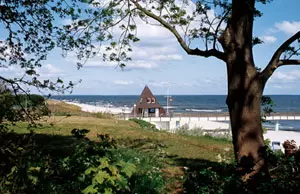 Seebrücke in Koserow
Photo: Kurverwaltung Koserow
Koserow at a glance
- Pier: The wave-shaped Koserow pier is almost 300 metres long.
- Height: Streckelsberg rises to 58 metres and is one of the striking elevations along Usedom’s outer coast.
- Accessibility: The beach access directly at the pier has few steps and is supplemented by stepping plates; a beach wheelchair is available to borrow from the lifeguards.
- History: The salt huts are reminders of the area’s former fishing industry and herring storage.
- Art: The Otto Niemeyer-Holstein Studio lies between Koserow and Zempin at Lüttenort.
Choose your beach section by the pier
The pier extends almost 300 metres into the Baltic Sea and serves as the main landmark by the water. The beach differs on either side: to the left of the pier are gentler dunes, while to the right a steep coast stretches along the shore, with steps leading down to the beach. Groynes divide the beach into bathing areas. If you need step-free access, use the accessible entrance directly at the pier, where stepping plates make it easier to get around on the beach. According to the local tourism website, the promenade and pier are also accessible.
When visiting the beach, the location in relation to the water matters more than making a blanket statement about the entire stretch of coast. ASB water rescue services supervise the guarded beach sections during the bathing season; the precise coverage depends on the season and section. A beach wheelchair can be borrowed free of charge from the lifeguards. If you want to avoid the steep coast and steps, stay by the accessible entrance or on the promenade; if you’re looking for coastal views, take the path up Streckelsberg.
Streckelsberg, the church and the salt huts
Streckelsberg rises 58 metres above the Baltic Sea. On a clear day, views from its wooded slope extend as far as Rügen and the Polish island of Wolin. The story that Klaus Störtebeker hid here is part of local tradition and should be understood as a legend. The hill is a nature and viewpoint destination; a visit can be combined with a walk along the steep coast.
The historic salt huts stand close to the pier. Fishermen stored salt there and used it to preserve herring; today, the group of historic buildings has been preserved, and one hut serves as a small museum and registry office. The old village centre is also home to the 13th-century fieldstone church. In summer, it hosts performances in the “Classics by the Sea” theatre series. These places tell three different parts of Koserow’s story: coastal fishing, village history and today’s cultural programme.
Lüttenort: a studio between Koserow and Zempin
The Otto Niemeyer-Holstein Studio is located at Lüttenort, between Koserow and Zempin, at the island’s narrowest point. The painter made his home there in 1933; the museum combines his historic house and studio with a garden he designed and the New Gallery, which opened in 2001. A visit therefore takes in both exhibition spaces and the artist’s original living and working environment.
Lüttenort can be reached on foot or by bike via signposted paths along the Baltic Sea dyke. According to the museum, Zempin railway station is 1.5 kilometres away; from there, you can combine a visit to the studio with a walk around Zempin. The museum presents changing exhibitions; guided tours of the house and studio offer insight into the historic rooms and the preserved S-Bahn carriage.
For the next leg of your trip, Loddin-Kölpinsee and Ückeritz lie to the south. These places differ in their locations between the Baltic Sea, the Achterwasser lagoon and their respective village centres. The Usedom overview places Koserow in the centre of the island. The Koserow accommodation selection can serve as a base if you plan to visit the pier, Streckelsberg and Lüttenort over several days.
Frequently asked questions about Koserow
Is beach access in Koserow accessible?
There is an accessible entrance directly at the pier, with stepping plates to make the route easier. A beach wheelchair can be borrowed free of charge from the lifeguards.
How high is Streckelsberg?
Streckelsberg is 58 metres high. On a clear day, views extend as far as Rügen and Wolin.
What were the salt huts?
Fishermen stored salt there and used it to preserve herring. Today, the historic group of buildings has been preserved; one hut serves as a small museum and registry office.
Where is the Otto Niemeyer-Holstein Studio?
The Lüttenort Museum is located between Koserow and Zempin, at the narrowest point of Usedom. It includes the artist’s house, studio, garden and New Gallery.
