
Eutin Castle: Museum and Gardens
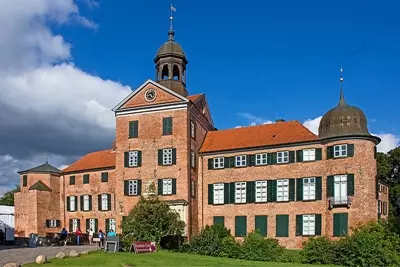 Schloss Eutin
Photo: © C Wiki Nordenfan CC-BY SA 4.0
Eutin Castle at a glance
The castle began as an episcopal administrative estate in the 12th century and developed from a medieval fortress into the residence of the Prince-Bishops of Lübeck. After the fire of 1689, reconstruction gave the complex its Baroque appearance. Today, the museum takes visitors through rooms furnished with original pieces, bringing court life, art and European connections to life. The ship models from the collection of the Russian tsars are among its most notable exhibits.
The castle garden opens out towards the Great Lake Eutin as an English landscape park. Designed from 1786 onwards, it leads past meadows, groups of trees and Neoclassical garden buildings. At the heart of the park is the historic kitchen garden, laid out from 1790 to supply the court kitchen and now a destination in its own right, with vegetable, fruit and ornamental beds. Together, the museum and garden offer a visit combining interiors, architecture and a walk outdoors.
From episcopal estate to residence: inside the museum
The complex’s four wings make the courtyard a natural place to begin a visit. From here, the architecture can be appreciated as a unified residential palace. Inside the museum, the route continues through halls and living quarters, where furniture, wall decorations, paintings and furnishings reveal the changing eras of court life. The rooms tell stories not only of princes and their guests, but also of servants, artists and the everyday workings of a court.
Notable stops include the Knights’ Hall, the Red and Yellow Salons, and the Russia Room. The three ship models from the tsars’ treasury point to the ties between the House of Schleswig-Holstein-Gottorp and the Russian ruling dynasty. The antependium in the castle chapel also offers insight into courtly devotion, craftsmanship and 17th-century furnishings. Visitors can explore the museum rooms at their own pace; the castle app provides additional stories and information about the exhibits.
The history of the complex helps visitors read its different architectural styles. The medieval fortress was followed by reconstruction in the Baroque style from the late 17th century onwards. From 1803, Eutin served as a summer residence, and the court attracted scholars and artists. Later, the Baroque garden was transformed into an English landscape park. These layers now sit side by side: the castle presents a sequence of stately rooms, while the garden extends the visit into the surrounding landscape.
Explore the castle and kitchen gardens
The castle garden is freely accessible during the day; the grounds are closed at night. A walk can begin on the south terrace, then follow paths between meadows and trees. The kitchen garden complements the landscape park with a more orderly layout: its beds, paths and historic orangery bring its role as a productive garden to life. The gardens can be visited without a museum ticket and also make a pleasant stand-alone walk along the lakeshore.
The castle museum’s opening hours vary by season. From March to June and from September to 23 December, it is open Tuesday to Sunday and on public holidays from 11 am to 5 pm; in July and August, it is open daily from 10 am to 6 pm. Special hours apply in winter. Admission to the museum is free for children and young people up to the age of 17. According to the latest visitor information, the castle, kitchen garden and café are accessible to wheelchair and rollator users.
Allow about an hour for a guided visit; a self-guided tour can be extended to suit your interests. If you would also like to explore the garden, set aside time for a separate walk. The railway station and town centre are within walking distance of the castle, making it easy to combine the museum, market square and town walks in a full day out. Designated parking is free at weekends; additional parking areas are nearby on weekdays.
Combine your visit with the town and region
Eutin’s town centre complements the castle grounds with its market square, historic buildings and lakeside paths. With accommodation in Eutin, you can explore the castle, lakeshore and old town without changing locations. For another historic highlight in the region, visit the Oldenburg Rampart with its archaeology and reconstructed settlement, or combine monastic history and natural history at Cismar Abbey.
An overview of more places to visit in Holstein brings coastal towns and inland destinations together. The Holstein region extends beyond the Holstein Switzerland area. In Eutin itself, the castle brings three perspectives together: the history of a residence with medieval roots, a public museum with original furnishings, and a freely accessible parkland beside the lake.
The Eutin Festival is part of the town’s seasonal cultural life. The organisers have cancelled the planned 2026 season. The castle museum and garden are independent attractions, so a day out can still combine the interiors, park and town walks.
Frequently asked questions about Eutin Castle
Can I visit the museum without a guided tour?
Yes. You can explore the museum at your own pace; the castle app adds stories and information about individual exhibits.
Is the castle garden free to enter?
Yes. The castle and kitchen gardens are open to the public free of charge during the day. The gardens are closed at night.
Will the Eutin Festival take place in 2026?
The organisers have cancelled the planned 2026 season. The castle museum and garden can be visited regardless.
