
Attractions in the Hanseatic City of Rostock
The Old Town of Rostock has a distinctly Hanseatic character. Kröpeliner Straße shines in new splendour as the city’s most important promenade, featuring examples of Brick Gothic architecture and University Square at its heart.
Just a few steps away stands Rostock’s largest church, St. Mary’s Church, built around 1290 on the model of Lübeck’s St. Mary’s Church. It boasts particularly rich furnishings, including an astronomical clock. St. Peter’s Church at the Old Market is Rostock’s tallest church at 117 metres, while nearby St. Nicholas’ Church ceased to serve as a parish church in 1974. Today it is a venue for cultural events, with offices and apartments housed in the upper floor.
The Stone Gate and Kröpelin Gate are the two largest surviving city gates. The latter, at the end of Kröpeliner Straße, houses part of the city’s Cultural History Museum, whose main location is the Holy Cross Monastery on University Square.
The long stretch of the City Harbour exudes a maritime atmosphere, with historic warehouses and new buildings in the same style, distinctive restaurants and ship moorings.
Since the International Horticultural Exhibition in 2003, the IGA Park has served as an exhibition and event centre, halfway to Warnemünde.
The undisputed favourite among year-round attractions is the Rostock Zoo.
During the run-up to Christmas, the Rostock Christmas Market, probably the largest in northern Germany, draws young and old from across the region and from Scandinavia. Neuer Markt, Kröpeliner Straße and Lange Straße are transformed into a sea of stalls and fairground rides.
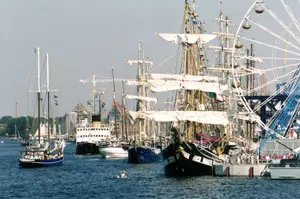 The second weekend in August is set aside in the Hanseatic city of Rostock for the Hanse Sail, the largest maritime event in Mecklenburg-Vorpommern. Up to 300 traditional sailing ships gather on the Unterwarnow between Rostock City Harbour and Warnemünde, making it—and the many accompanying events—a magnet for more than 1 million visitors.
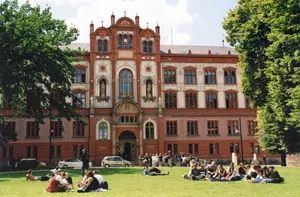 Universität Rostock
Photo: © Tourimuszentrale Rostock
Universität Rostock
Photo: © Tourimuszentrale Rostock
