
Discover Warnemünde
Warnemünde is easy to explore in a day, combining the beach with its historic harbor: first stroll through the lanes along the Alter Strom to the pier and lighthouse, then head to the broad sandy beach. The ferry crosses to the other side of the Warnow to Hohe Düne and onward toward the Rostock Heath.
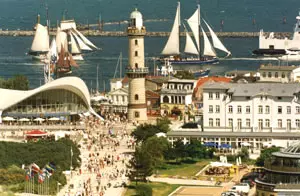 Hanse Sail in Warnemünde
Photo: Tourismuszentrale Hansestadt Rostock & Warnemünde
At a glance: beach, Alter Strom and ferry
- For a first walk around town: Alter Strom, Alexandrinenstraße, Mittelmole and the lighthouse are close together; from there, the promenade leads to the beach.
- Beach: Rostock’s official beach map divides Warnemünde’s roughly 2.2-kilometer-long beach into sections. Access and permitted uses vary depending on the beach entrance.
- Across the Warnow: The ferry connects Warnemünde with Hohe Düne and carries pedestrians, bicycles and cars. The crossing takes about four minutes.
- Public transport: S-Bahn line S1 connects Warnemünde directly with Rostock Central Station.
Start your town walk at the Alter Strom
The Alter Strom is the former mouth of the Warnow and is still a harbor basin, with fishing boats, sightseeing vessels and moorings. For a first impression, take a stroll along the waterfront: boats and fishing businesses line one side, while the houses along the water and the lanes of the old seaside resort stand on the other. The view and activity change as ships come and go, so this is more than simply a route between the station and the beach.
Historic streets branch off from the waterfront promenade. Alexandrinenstraße is one of the oldest streets in the former fishing village and makes a good detour if you’d like to explore beyond the waterfront. The side streets offer a quieter way to discover the older town center. If you’re short on time, keep your walk brief: follow the west bank of the Alter Strom to the lighthouse, then continue to the beach promenade.
Harbor entrance, lighthouse and beach promenade
Warnemünde Lighthouse was built in 1897 and stands right at the entrance to the Neuer Strom. Together with the neighboring Teepott, it marks the transition from the old harbor area to the beach promenade. From the pier, you can see where the harbor entrance meets the open Baltic Sea; the West Mole extends far out toward the sea. In strong winds or rough seas, enjoying the view from shore is just as good an alternative to walking all the way to the end of the pier.
The promenade runs alongside the beach and is a good option if you want to keep your walk short. The sandy beach is unusually broad and stretches for more than two kilometers. The location of the beach entrance is convenient for families: Rostock’s beach authority lists children’s beach areas at entrances 2, 3 and 9 to 11, among others. During the bathing season, lifeguards are stationed in the designated sections 3 to 19, as well as 23 and 24. Toilets are available at several entrances, including 1, 3, 4, 6, 10 and 18.
Beach use is also regulated by section. The official map distinguishes between textile, nudist and mixed areas; the boundaries can be identified on site at the beach entrances. So choose an entrance that matches the section you want, rather than looking for the right area once you’re already on the beach. The central section is a good choice for a short visit near the lighthouse and Teepott; if you’re looking for a children’s beach or a particular type of beach area, it’s best to check the entrance number.
Take the ferry to Hohe Düne
The ferry crosses the Warnow between Warnemünde and Hohe Düne. You can reach the eastern bank on foot or by bicycle, and cars can also be carried. The crossing takes about four minutes. Rostock’s public transport information lists a 20-minute service during peak travel times, and in summer sometimes every ten minutes; frequency and operating hours vary by time of day and season.
Hohe Düne and the opposite bank aren’t an extension of the town center, but a change of scenery: harbor facilities and stretches of beach give way to paths leading toward Markgrafenheide and the Rostock Heath. For a short outing, simply take the ferry there and back and add a walk or some time at the beach on the eastern shore. If you’re planning a longer hike, the marked routes in the Rostock Heath include paths starting from Hohe Düne, for example toward Schnatermann or Heiligen See. These routes are much longer than a walk around town, so plan them as a separate outing.
Warnemünde’s S-Bahn is part of the regional transport network, but the ferry to Hohe Düne is specifically excluded from the GästeCard. Plan the crossing as a separate journey. If you’re staying in Warnemünde, you don’t need the ferry: the Alter Strom, beach and lighthouse can all be reached on foot. The ferry is mainly useful when your destination is on the other side of the Warnow.
Choose accommodation to suit your plans
If you want to get to the beach early or take an evening stroll along the Alter Strom, consider the location when choosing where to stay: central accommodation saves time getting between the harbor, promenade and beach, while staying in Hohe Düne puts you closer to the opposite bank. Find accommodation in Warnemünde, along with details of available amenities, here: Accommodation in Warnemünde.
Warnemünde is also a good base for exploring other parts of Rostock and the coast. For a change of pace between a seaside resort and a larger city, consider a trip to the Hanseatic city of Rostock. If you continue west along the coast, the page about Nienhagen introduces another Baltic Sea resort on the steep coast. East of Rostock, you can combine a beach holiday in Graal-Müritz with a visit to the Rostock Heath; farther west, Kühlungsborn is another option, with its own seaside promenade.
Frequently asked questions about Warnemünde
How can I combine the beach with the Alter Strom?
Follow the west bank of the Alter Strom to the lighthouse and continue to the beach promenade. From there, you can reach the sandy beach without making a second trip. Children’s beach areas are designated at entrances 2, 3 and 9 to 11.
When is the ferry to Hohe Düne worthwhile?
It’s useful if you want to visit Hohe Düne or the paths toward Markgrafenheide and the Rostock Heath. Pedestrians, bicycles and cars can cross; the roughly four-minute trip is a way across the Warnow, not part of a walk around the Alter Strom.
Is the Warnemünde ferry included in the GästeCard?
No. The GästeCard is valid on the designated Rostock regional transport network, but the ferry between Warnemünde and Hohe Düne is excluded. You’ll need a separate ticket for the crossing.
Which beach entrance is best for families?
Rostock’s beach authority lists children’s beach areas at entrances 2, 3 and 9 to 11. Lifeguards and toilets are available at several numbered entrances; choose the one that suits the section you want and the facilities you need.
