
Hanseatic City of Rostock
Rostock’s Old Town, city harbor, and Warnemünde lie along different sections of the Warnow. For a first day in the city, a good walking route runs from Kröpeliner Tor via Universitätsplatz and Kröpeliner Straße to Neuer Markt.
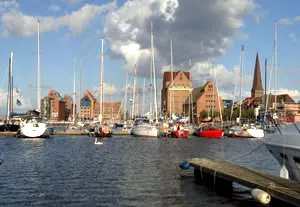 Rostocker Stadthafen
Photo: © Tourismuszentrale Hansestadt Rostock & Warnemünde
Rostock at a glance
- Historic center: Kröpeliner Tor, Universitätsplatz, Kröpeliner Straße, Neuer Markt, and St. Mary’s Church.
- Harbor: The city harbor lies on the Unterwarnow; the Old Town and the waterfront are separate stretches of the route.
- Seaside resort: Warnemünde lies at the mouth of the Warnow and offers a beach, the Alter Strom, and historic lanes.
- City tour: The public walking tour of the historic center lasts around 90 minutes and meets at the Rostock Tourist Information office, Universitätsplatz 6.
- Accommodation: To combine the city and the beach, you can stay in Rostock or nearby Warnemünde and visit each destination separately.
Explore the Old Town on a continuous walking route
Kröpeliner Tor marks the western entrance to the city center. From there, the pedestrianized Kröpeliner Straße runs toward Neuer Markt. Along the way, you’ll find brick gabled buildings, shops, cafés, and turnoffs to Universitätsplatz. The square opens up views of the university and other architectural landmarks. If you’d like to visit a museum, the Cultural History Museum is housed in the Monastery of the Holy Cross. For a first orientation, the west-to-east route from the gate to the market is more manageable than trying to fit in every church and harbor spot in one morning.
The Town Hall and St. Mary’s Church stand on Neuer Markt. The church is a major stop not only for its brick architecture: inside, you’ll find the 15th-century astronomical clock. Afterward, you can take a loop through the eastern Old Town to St. Peter’s Church and St. Nicholas’ Church. These two churches are in a different neighborhood from the shopping thoroughfare; adding them extends your visit and takes you through smaller lanes and residential streets rather than just the bustling city center.
If you’d prefer a guided route, you can join the public tour “Rostock’s Historic Center.” It runs from Kröpeliner Tor to Neuer Markt, with stops at Universitätsplatz, the Monastery of the Holy Cross, Kröpeliner Straße, and St. Mary’s Church. Lasting an hour and a half, the tour makes a good introduction before you explore individual places in more depth on your own. It starts at the Rostock Tourist Information office, Universitätsplatz 6; the tourism office publishes tour dates and booking details online for each season.
Plan the city harbor and eastern Old Town separately
The city harbor offers a glimpse of Rostock’s maritime side on the Unterwarnow. It’s worth walking the waterfront as its own stretch rather than treating it as a quick loop around a harbor basin: the promenade follows the water’s edge and can be linked with the Kröpeliner-Tor-Vorstadt neighborhood. Here, streets lined with late-19th-century buildings, small shops, and cafés shape the atmosphere. An official walking route through the city harbor and KTV is around five kilometers long and starts and ends at the Zum Alten Fritz brewery restaurant; tram stops at Kröpeliner Tor or Schröderplatz offer the option of joining the route for a shorter walk.
On the other side of the city center, the eastern Old Town offers a quieter route with a more intimate feel. St. Peter’s and St. Nicholas’ churches, historic house façades, and remnants of the city fortifications provide a different backdrop from the grand squares in the center. From the viewing platform at St. Peter’s Church, you can see across the Old Town, city harbor, and Warnow. If you’d like to include a museum, it’s best to choose one along your planned route so that the walk between the city center, the monastery quarter, and the eastern Old Town stays manageable.
Follow the Warnow to Warnemünde
Warnemünde is not another Old Town district, but a seaside resort at the mouth of the Warnow. The trip between the city center and the coast is especially worthwhile if you’d like to combine your outing with a beach visit or time around the harbor. In Warnemünde, Am Strom and Alexandrinenstraße wind through the historic fishing quarter. The Mittelmole offers views of the Alter Strom and the promenade; at the lighthouse and the neighboring Teepott building, the beach promenade meets seaside resort architecture. Built in 1897, the lighthouse is a prominent landmark.
The beach is up to 200 meters wide, stretches for just over two kilometers, and has mostly shallow water near the shore. This is useful for families to bear in mind when choosing a section; the beach access points are also divided into textile, nudist, and mixed areas. For a separate visit, find out more about the beach, lighthouse, and lanes in the seaside resort of Warnemünde. If you’re looking for a quieter route through woodland and along the steep coast, you could consider nearby Nienhagen as a separate outing; it lies west of Warnemünde and is not part of Rostock city center.
Rostock as a base for exploring nearby places
For a longer stay, you can vary your day trips: the seaside resort of Heiligendamm combines a beach visit with the early history of seaside resorts, while Graal-Müritz lies between the Baltic coast, the Rostock Heath, and a rhododendron park. This keeps your city sightseeing and nature outings manageable instead of trying to cover every distance in a single day.
If your trip lasts several days, you can choose where to stay based on whether you’d rather spend your evenings in the city center or near the coast. Compare places to stay in Rostock if you’re focusing on the city; if you’d like to walk straight to the beach and the Alter Strom in the morning, you can instead browse places to stay in Warnemünde. The two locations serve different purposes: Rostock makes it easier to get to the Old Town and city harbor, while Warnemünde puts you closer to the coast and seaside resort.
Frequently asked questions about Rostock
What should I include in a first visit to the Old Town?
A good basic route runs from Kröpeliner Tor via Universitätsplatz and Kröpeliner Straße to Neuer Markt, with its Town Hall and St. Mary’s Church. If you’d like to see more churches and lanes, plan the eastern Old Town as a second stretch.
How long does the public city-center tour take?
The “Rostock’s Historic Center” tour takes about an hour and a half and runs from Kröpeliner Tor to Neuer Markt. It meets at the Rostock Tourist Information office at Universitätsplatz 6; the tourism office publishes seasonal dates and booking information.
How is Warnemünde different from the city center?
Warnemünde lies at the mouth of the Warnow and is a seaside resort with a wide beach, the Alter Strom, a lighthouse, and the Teepott. Rostock city center is known for its Hanseatic brick architecture, churches, squares, and city harbor.
