
Excursion Ideas in Mecklenburg
The Mecklenburg Coast is the birthplace of German seaside resort culture. The first seaside resorts, Heiligendamm (since 1793) and Boltenhagen (since 1803), are still popular destinations today. The varied inland region stretches as far as Schwerin, the state capital.
Archaeological Open-Air Museum Groß Raden
Located in the heart of Sternberg Lake District Nature Park, between the towns of Wismar, Schwerin and Güstrow, a former Slavic ring fort has been transformed into a spacious open-air museum. Open year-round, the museum offers a vivid insight into the living conditions and daily life of the Slavs in the 9th and 10th centuries.
The Poel Cog
In the late 1990s, the well-preserved wreck of a Hanseatic cog was discovered off the western coast of Poel Island. The wreck itself is being preserved, while a replica built in Wismar set off on its maiden voyage in 2005 and can be booked for sightseeing cruises.
Schwerin-Mueß Open-Air Museum
On the southern shore of Lake Schwerin, in the village of Mueß and in the heart of a protected landscape, the Schwerin-Mueß Open-Air Museum explores work and everyday life in a Mecklenburg village from the 18th century to the early 20th century. Its extensive grounds host a variety of cultural events, markets, theatre performances and children’s festivals.
Molli Narrow-Gauge Railway
The narrow-gauge railway, known today as “Molli,” has run between Bad Doberan and Heiligendamm since 1886. The line was extended to today’s Kühlungsborn in 1910. The 15.4-kilometre route, with a track gauge of 900 mm, takes about 40 minutes to travel and runs hourly during the high season. Since 1969, the railway has been restricted to passenger services. In Bad Doberan, the “Molli” runs right through the town’s streets.
Lighthouse on the Buk
Commissioned in 1878, the 21-metre-high lighthouse on the Buk, in the inland area near Kühlungsborn and the village of Bastorf, was one of the first electrified lighthouses in Germany. Perched on a 78-metre-high hill, it is also Germany’s highest-situated lighthouse. Visitors have been able to climb it again since 2003.
Gelbensande Hunting Lodge
On the southern edge of the Rostock Heath, between Rostock and Ribnitz-Damgarten, the former Gelbensande Hunting Lodge—one of the finest examples of Mecklenburg architecture—can be visited following extensive restoration. It opened as a ducal hunting lodge in 1885 and became a meeting place for many members of the European nobility. Today it hosts changing exhibitions and numerous cultural events. Weddings can also be held at Gelbensande Hunting Lodge.
Ernst Barlach Memorial in Güstrow
Ernst Barlach, one of Germany’s most important artists, lived in Güstrow from 1910 until his death in 1938. Here, in his studio house on Lake Inselsee, he created most of his best-known works. Today, the building houses part of the Ernst Barlach Memorial, where more than 100 sculptures are on display. Further works can be seen in Gertruden Chapel in the town centre and in Güstrow Cathedral.
Güstrow Wildlife Park
The diverse landscapes of Mecklenburg-Western Pomerania—with hills, lakes, meadows, forests and rivers—come together across more than 200 hectares in a spacious park on the outskirts of Güstrow, about 40 kilometres south of the Hanseatic city of Rostock. Walk-through wildlife enclosures, aviaries and an underwater tunnel make this a great destination for the whole family in every season.
Mecklenburg Lake District
Formed by the landscape-shaping forces of the last Ice Age, the Mecklenburg Lake District covers most of the state of Mecklenburg-Western Pomerania and northern Brandenburg. Most of its smaller and larger lakes are connected to one another and, via the Elbe, Elde and Havel rivers, to Hamburg and Berlin. The northern section, which is not connected to the south, drains into the Baltic Sea via the Warnow and Peene rivers.
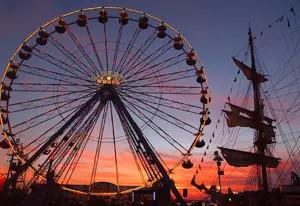 HanseSail
Photo: © Tourismuszentrale Rostock & Warnemünde
HanseSail
Photo: © Tourismuszentrale Rostock & Warnemünde
