
Sights in the Hanseatic City of Wismar
Most of the sights in the Hanseatic City of Wismar date back to the Hanseatic period, as Wismar was an important member of this league of merchants, particularly because of its harbour. The old town of the Hanseatic City of Wismar, part of the UNESCO World Heritage Site, contains most of the evidence of historic architecture. Measuring exactly 100 by 100 metres, the market square is one of the largest in northern Germany. One side is occupied by the town hall, which was built in its present form between 1817 and 1819. The original merchants’ house, “Alter Schwede”, also stands on the market square. It dates from 1380, but did not receive its name until 1878, as a reminder of the period of Swedish rule.
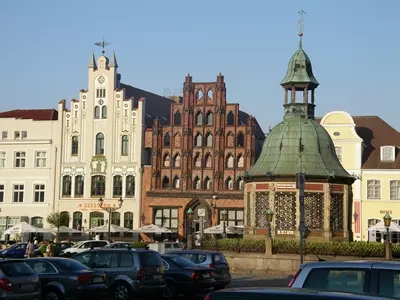 Markt mit Haus Alter Schwede
Photo: © Wikimedia / kasselatze CC BY-SA 3.0
Markt mit Haus Alter Schwede
Photo: © Wikimedia / kasselatze CC BY-SA 3.0
A popular meeting place is the well-preserved Wasserkunst on the market square, built around 1600 in the Dutch Renaissance style. It supplied Wismar with water until 1897.
Built for former mayor Schabbell in the 16th century, the “Schabbellhaus” now houses Wismar’s city history museum. Visitors can learn about the history of Wismar here, with a particular focus on the Hanseatic period and the period of Swedish rule (1648–1815). Since 1990, numerous small lanes around the market square have been reconstructed, offering an authentic glimpse into Wismar’s commercial life in the past. They include the original home of the Karstadt retail group, built in 1908, which documents the beginnings of this major German department store chain in a small museum.
One of the city’s three churches is St Nicholas’ Church, whose 37-metre-high nave is considered the fourth tallest in Germany. While it was known as the sailors’ church, St George’s Church served as the place of worship for craftspeople and tradespeople. Its careful reconstruction, carried out under the supervision of the heritage authorities, began in 1990. All that remains intact of St Mary’s Church is its 80-metre-high tower. The Bürgerpark was created by combining historic parkland with the newly laid-out grounds for the 2002 State Garden Show. The Old Harbour is also well worth a visit, along with the Wassertor, the only surviving city gate in Wismar. The harbour is also home to a replica of the Poel cog, which offers trips into the waters off Wismar.
