
Königsstuhl
If Rügen has almost become a symbol of Germany’s Baltic Sea islands, then Königsstuhl is unquestionably the landmark of the Baltic Sea island of Rügen. It rises amid an almost 12-kilometre stretch of chalk cliffs on the island’s northeastern coast, extending from Sassnitz to Lohme. This imposing natural feature has fascinated and captivated people for centuries. Caspar David Friedrich’s famous painting depicts chalk pinnacles along the cliffs, which were mistakenly identified as the Wissower Klinken. However, the Wissower Klinken did not yet exist in that form in Friedrich’s time. These chalk outcrops fell victim to coastal erosion in 2005 and collapsed into the sea. The best-known chalk cliff, Königsstuhl, rises 118 metres above the Baltic Sea in the heart of Jasmund National Park. The plateau, covering about 200 square metres, has been part of Königsstuhl National Park Centre since 2004.
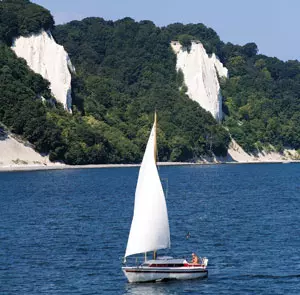 Segler vor dem Königsstuhl
Photo: © Tourismus Service Sassnitz
Segler vor dem Königsstuhl
Photo: © Tourismus Service Sassnitz
However, the “footfall” of thousands of visitors took such a heavy toll on the chalk platform that access to the plateau had to be closed and an alternative developed: a spectacular steel arch, suspended freely above the platform. The new “access” to Königsstuhl is scheduled to open at Easter 2023.
Königsstuhl is said to have been named after the Swedish King Charles XII, who watched a naval battle from the cliff in 1715 and had a chair brought to him. According to another version, whoever first manages to climb the cliff from the sea will become king. Even today, a walk from Sassnitz—either along the water below the cliffs or on the high trail above the steep coast—is a special experience. However, coastal erosion makes extreme caution essential here. Since 2005, several major cliff collapses have occurred, especially after prolonged periods of rain. The steps from Königsstuhl down to the shore are closed because of the risk of collapse and are unlikely to reopen.
Jasmund National Park
Covering around 3,000 hectares, Jasmund National Park is Germany’s smallest national park. It encompasses the entire chalk coast north of Sassnitz, a 500-metre-wide strip of water, as well as the beech forest and adjoining areas on the ridge of the Stubnitz. The small waterfalls formed by streams that rise on the ridge and cascade down the chalk coast are particularly impressive; the Kieler Bach is one example. The National Park Centre, located on high ground near Königsstuhl, opened in 2004 and is jointly run by the town of Sassnitz and the WWF. With around 300,000 visitors a year, it is one of Germany’s most visited national park centres. It offers visitors—including many holidaymakers on the Baltic coast—interactive information about the unique natural environment of this coastal area. Short guided tours, an exhibition featuring “walks” beneath the Baltic Sea, underground and through the Ice Age, and a multimedia show featuring a flight over the national park vividly showcase the diversity of Rügen’s natural environment. A spacious outdoor area with a climbing frame, nature playground and explorers’ tent offers plenty of interest for a family holiday on the Baltic coast. The National Park Centre is accessible to visitors with disabilities. Visitors can reach the National Park Centre from the large Hagen car park either on foot (about 45 minutes) or by shuttle bus.
Königsstuhl National Park Centre
Stubbenkammer 2
18546 Sassnitz
Telephone +49 (0) 38392 6617-0
