
Sights in the Hanseatic City of Stralsund
Within the walls of the old Hanseatic city of Stralsund many historic examples of Brick Gothic architecture have been preserved. At the same time, the city boasts examples of bold new design approaches. In 2004, Stralsund’s Old Town was declared a UNESCO World Heritage Site.
Visitors to the German Oceanographic Museum, housed in the former St. Catherine’s Monastery, can discover everything about the world of the seas. The same monastery’s spacious buildings are also home to the Cultural History Museum, whose exhibitions focus primarily on the regional history of Pomerania.
Stralsund’s City Archive, in the former St. John’s Monastery, is not just a “regular” information service; it also displays unique exhibits from the history of this once-prosperous city.
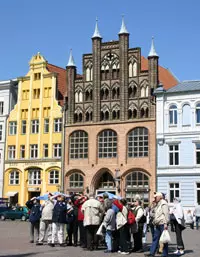 Among the well-preserved examples of northern German Brick Gothic are the ensemble around the Old Market Square, with its Town Hall, St. Nicholas’ Church and Wulflam House; the surviving sections of the city walls, including Knieper Gate and Küter Gate; St. James’ Church and the Church of the Holy Spirit; and St. Mary’s Church on the New Market Square. With a tower 104 metres high and a nave 33 metres high, it is considered the largest brick church in the Hanseatic region after St. Mary’s Church in Gdańsk.
The Ozeaneum is a visionary project. Opened in 2008 on the Harbour Island, it was built as an extension of the German Oceanographic Museum. Its exhibition areas, North and Baltic Sea aquariums and Giants of the Sea exhibit set new standards in presenting the natural world of the sea, accompanied by characteristic sounds.
A maritime landmark in the history of German seafaring can be found in the harbour. The three-masted barque Gorch Fock I awaits visitors there, offering a glimpse into the world of a great sailing ship.
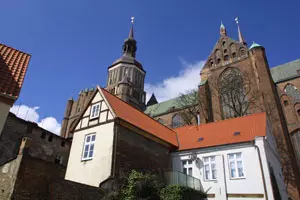 Marienkirche Stralsund
Photo: © Tourismuszentrale Stralsund
Marienkirche Stralsund
Photo: © Tourismuszentrale Stralsund
