
Hanseatic City of Stralsund
Stralsund lies on the Strelasund opposite Rügen, combining a compact brick-built Old Town with a harbour right on the water. For a first visit, a good route is the Alter Markt, St. Nicholas’ Church and the harbour island; museums can be added to the city walk depending on your interests.
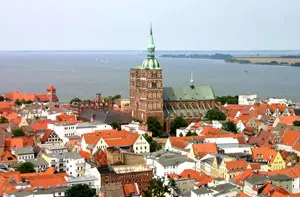 Blick auf das Rathaus und die Nikolaikirche
Photo: © Tourismuszentrale Stralsund
Stralsund at a glance
- Old Town: The Town Hall and St. Nicholas’ Church define the Alter Markt; together with Wismar, the historic town is a UNESCO World Heritage Site.
- Maritime museums: The OZEANEUM is on the harbour island, while the MEERESMUSEUM is housed in the former St. Catherine’s Monastery in the Old Town.
- Harbour: Warehouses, ships and views across the Strelasund towards the Rügen Bridge lie between the Old Town and the water.
- Planning: You can pair a museum visit with a walk; each museum is a substantial destination in its own right.
Alter Markt and Brick Gothic architecture
Start at the Alter Markt. The Town Hall, with its richly articulated show façade, stands right next to St. Nicholas’ Church, illustrating how secular and religious power were displayed side by side in a Hanseatic city. From here, short lanes lead past gabled houses and warehouses. Rather than simply ticking off as many buildings as possible from the outside, take time to notice the varied façades, gateways and courtyards: Stralsund’s brick architecture tells the story of trade, seafaring and the city’s role in the Baltic region.
The Old Town is part of the UNESCO World Heritage Site “Historic Centres of Stralsund and Wismar”. You can see why as you walk from the Alter Markt towards the harbour: the street plan leads down to the water, while churches and merchants’ houses mark the former trading city. If you’d like to learn more about the site’s World Heritage status, there is a dedicated exhibition at Ossenreyerstraße 1. According to the city, it is open daily from April to October and Monday to Saturday from November to March, so opening days vary by season.
Stralsund also bears traces of its Swedish period. For a long time, the city was the administrative centre of Swedish Pomerania. As you walk through the Old Town, look beyond the Hanseatic era to the buildings’ later uses and construction phases. Nearby places to base yourself for a trip include Greifswald on the Ryck and Anklam on the Peene.
OZEANEUM or MEERESMUSEUM?
The two museums focus on different subjects. The OZEANEUM stands on the harbour island and explores the northern seas through aquariums and exhibitions. Highlights include the large “Open Atlantic” aquarium, a walk-through tunnel tank and the “1:1 Giants of the Seas” exhibition, featuring life-size whale models. Humboldt penguins live on the roof terrace, which also offers a view back towards the Old Town skyline. The museum is especially suited to visitors who want to combine marine life and aquariums with a harbour setting.
The MEERESMUSEUM, by contrast, is located in the former Dominican monastery of St. Catherine in the city centre. Reopened in 2024, it explores topics including tropical underwater worlds, sea turtles and marine research. Its location makes it a good addition to a walk through the Old Town or an alternative for a day with more of a cultural and historical focus. Choose whether to visit one or both museums on separate parts of the day, depending on the topics that interest you and the time available.
The German Oceanographic Museum publishes seasonal opening hours and ticket information. Combined tickets are available for several museum locations; according to the museum, each ticket is valid for one visit to each site and can be used over a three-month period. This means a visit to the OZEANEUM does not have to take place on the same day as a visit to the MEERESMUSEUM.
Harbour island, the Strelasund and excursions
After visiting the OZEANEUM, continue across the harbour island to the ferry pier and walk along the quayside. Here, the museum, moorings and working harbour sites sit side by side. The Gorch Fock I is also in the harbour area and makes a distinct destination of its own; opening times and visiting conditions vary, so don’t assume it will automatically be accessible as part of your walk. If you’d rather stay by the water after the museum, follow the Sund promenade or enjoy the views towards Dänholm and the connections to Rügen.
Stralsund is also a good starting point for understanding the links between the mainland and the island. The Rügen Bridge and the Rügendamm causeway connect the city to the island. If you’re staying in town, the Stralsund accommodation selection can help you find a base, while the outing itself can be planned as a walk between the market square and the harbour. For coastal destinations farther afield, see the overview of Usedom Island—a different kind of trip from a day in Stralsund’s Old Town.
Frequently asked questions about Stralsund
What can I see in Stralsund on my first day?
Combine the Alter Markt with the Town Hall and St. Nicholas’ Church, then walk to the harbour and decide whether the OZEANEUM fits into your schedule. The MEERESMUSEUM is back in the Old Town and works well as a separate visit.
What’s the difference between the OZEANEUM and the MEERESMUSEUM?
The OZEANEUM on the harbour island focuses mainly on the northern seas, with large aquariums and exhibitions. The MEERESMUSEUM, in St. Catherine’s Monastery, features tropical underwater worlds and sea turtles, among other things.
Is Stralsund’s Old Town a UNESCO World Heritage Site?
Yes. Stralsund and Wismar together make up the World Heritage Site of the historic centres. The Alter Markt and the route to the harbour offer clear examples of Hanseatic brick architecture.
Can I visit both marine museums in one day?
It’s possible, but each museum has substantial exhibitions of its own. If you want to explore them in depth, spread your visits across different parts of the day; the museum offers a combined ticket valid for several months.
