
The Dune
During floods, it is meant to protect the hinterland, and it is also, quite literally, part of a seaside holiday—at least on the Baltic Sea. To protect it from wind erosion, it was planted with hardy marram grass. Yet in some places even shrubs and trees have managed to put down roots in the sand. The “standard dune” is covered in vegetation, rises about two metres above the beach and is up to thirty metres wide. On the side facing away from the water, it slopes down into an area covered with shrubs or even trees. In many parts of the Baltic coast, it forms part of a dune forest that often stretches more than a kilometre inland. Elsewhere, as in Denmark or Poland, its sheer scale gives it a desert-like feel.
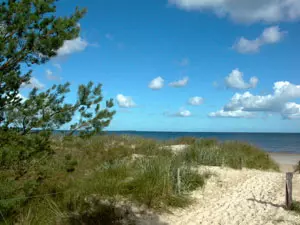 Dünenübergang bei Karlshagen auf Usedom
Photo: © nordlicht verlag
Dünenübergang bei Karlshagen auf Usedom
Photo: © nordlicht verlag
The dune on Usedom
As I walk over the dune, I can hear the noise from the promenade, feel the scorching sun—or sometimes the fierce wind. The gentle climb to the crest of the dune begins. The sounds I heard before grow quieter and blend together; new ones gradually emerge: the sound of waves! In the morning, when dew on the shrubs’ leaves welcomes the day—and attracts mosquitoes—the walk can sometimes become a little faster.
Then I gaze into the distance, towards the horizon; the (usually) blue expanse of water and the broad sandy beach come into view. At dawn, meanwhile, you can see the lights of ships at anchor off Świnoujście, while the newly risen sun sends a greeting over the Streckelsberg.
The few steps over the dune become a passage into another world. The scorching sun is tempered by a cooling breeze—or the other way round: the stiff breeze is left behind on the other side of the dune crest.
It is a world of open space and water, where the scale changes in an instant. Thoughts drift away, mingling with the shifting scraps of white cloud. The constraints of everyday life are left behind, transformed into lightness and a longing for boundlessness. Rainer Höll
