
Extraordinary collecting expedition for the OZEANEUM in Stralsund
In spring 2008, the OZEANEUM opened on Stralsund’s harbour island as another site of the German Oceanographic Museum and, at the same time, the largest new museum building in northern Germany.
The main attraction is its nearly 40 seawater aquariums, some of them enormous, which take visitors on a journey through the underwater world of the northern seas. In the Baltic Sea Aquarium, visitors descend directly into the waters of Stralsund harbour and experience the diverse flora and fauna of the region’s different marine environments. Alongside familiar fish species such as flounder and plaice, the aquariums are home to unusual creatures like the Chinese mitten crab. The OZEANEUM gives Stralsund the largest exhibition on the Baltic Sea in the entire Baltic region.
The North Sea Aquarium presents the habitats of the North Sea, the North Atlantic and the Arctic Ocean. A spacious walk-through aquarium is dedicated to Heligoland, Germany’s only rocky island. A tidal pool simulates the ebb and flow of the tide, while the surf pool brings the waves to life. The recently discovered deep-sea corals of the Atlantic are presented on an unprecedented scale. The largest tank in the OZEANEUM, the schooling fish tank, holds 2.6 million litres of water.
The exhibitions on the exploration and use of the world’s oceans feature numerous original exhibits. Interactive play and discovery stations help children understand the importance of the oceans. A simulated journey into the depths takes place inside a replica research submersible cabin.
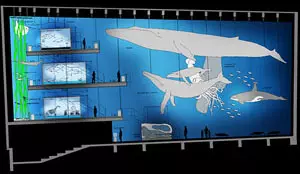 Special emphasis is placed on presenting the “Giants of the Seas.” Life-size whale models soar through the full height of the exhibition space. The largest exhibit is a 28-metre-long model of a blue whale. Visitors can also see a sperm whale diving as it battles a giant squid, an orca, and a humpback whale with its calf. The dramatic highlight is a sound installation featuring the blue whale’s deep calls, which can travel hundreds of kilometres, the songs of the humpback whale and the clicks sperm whales use to locate their prey at depths of up to 3,000 metres
Naturally, visitors will search in vain for a live whale at the OZEANEUM. But many other marine creatures have now moved into their new home. October 2007 was devoted to the first collecting expedition for the OZEANEUM for the team led by Dr Nicole Kube, head of aquariums at the German Oceanographic Museum. Since spring 2008, visitors have been able to admire the inhabitants of the northern seas here. Unlike many tropical marine species at the museum, these animals are not available through the aquarium trade, so the team travelled to Ålesund on Norway’s Atlantic coast. The German Oceanographic Museum has a close, cooperative relationship with the aquarium in Ålesund. The Norwegian team helps stock the OZEANEUM’s aquariums, while the Stralsund aquarists share their experience with tropical tanks.
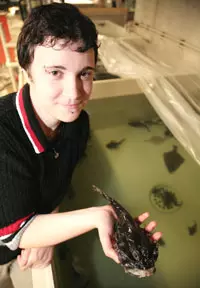 Fish were carefully collected from the waters around Ålesund using nets, traps and even bags, so they could make the journey to Stralsund in the best of health. Fishing with a rod also proved successful, particularly for saithe. Autumn was chosen for the expedition because especially many species can be found along the coast at that time of year. A later date was not an option, as the weather was set to worsen week by week.
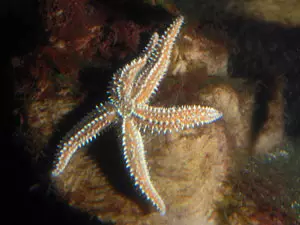
The OZEANEUM’s first inhabitants include scorpionfish, rockfish and wrasses, numerous eels, colourful cuckoo wrasses, starfish, magnificent sea urchins, lobsters and two monkfish. All three shipments arrived at the new museum building in mid-October 2007, each after a 20-hour journey in a refrigerated truck specially adapted for the purpose. The truck cooled the water containers to 12 degrees Celsius, the temperature of the North Atlantic, and supplied oxygen to the OZEANEUM’s future stars. The two managing directors of OZEANEUM Stralsund GmbH, Dr Harald Benke and Markus J. M. Bloching, were delighted by the many new arrivals as aquarium technician Rolf Wilsch opened the transport containers for the first time after the long journey. The number of fish and their good condition thrilled the aquarium technicians and animal keepers, who had been working tirelessly to prepare the quarantine tanks for their new residents.
 The journey to stock the Baltic Sea Aquarium is comparatively short, since the Baltic Sea lies right on Stralsund’s doorstep. Further collecting expeditions to various destinations are planned for spring 2008. In the meantime, the “Norwegian” fish will hopefully have settled well into their new home. From spring 2008, visitors to the OZEANEUM will be able to admire them, along with many other marine animals, in the new habitat aquariums modelled on natural environments.
Text: Diana Quade/German Oceanographic Museum (DMM)
Photos/graphics: Atelier Lohrer (2), Christian Rödel, Paul-Peter Reinmuth
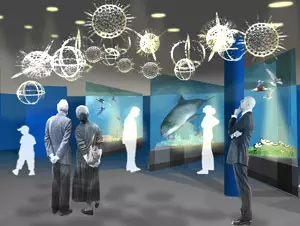 Ostsee-Ausstellung im OZEANEUM Stralsund (Grafik: Atelier Lohrer)
