
Impressions of the Darß
As recently as 1990, east of Zingst, signs, camouflage-painted huts and a fence that had already begun to fall into disrepair were reminders of a firing range from which aircraft targets over the Baltic Sea had been shot at for decades. Today, the animals and plants living in these unique dune landscapes are protected from overzealous nature lovers.
The chain of the three former islands of Fischland, Darß and Zingst is now a peninsula, and few can claim to have explored every aspect of it in the depth it deserves. The wildlife and plant life, changes to the landscape, history, culture, architecture and, not least, the people of this region are all well worth lingering over. Personal impressions from numerous visits to the area are intended to spark curiosity.
Ahrenshoop
It was autumn 1995. Our usual walking route led south from the southernmost beach access point at Ahrenshoop. For years, a stone groyne in the water had protected a small stretch of beach from erosion. After about 1,000 metres, we climbed a sturdy metal staircase—about 20 metres high and ten metres from the water—up the steep cliff to observe wind erosion along its upper edge. On the way back, we followed the path along the top, past the remains of a concrete bunker and numerous rose-hip bushes, to a café named after a groyne that was usually our midway stop. A few days later, one of the storm surges so typical of the Baltic showed its force. And so we were drawn back to the spot. At first, we were alarmed by the damage to the dune, whose remaining three metres had protected a house from flooding. The usual path beneath the cliff looked completely different, and the staircase had vanished without a trace.
Zingst
A few hundred metres east of Zingst, motor vehicles have to stop; bicycles are now in their element. The truly adventurous set out on foot to reach the end of the peninsula. The asphalt road divides the dune area—whose military use is finally a thing of the past—from the pastures of Zingst’s large cattle-breeding operation: two important aspects of nature and its protection.
Our goal was to see the cranes. At Pramort, the easternmost point of the Zingst peninsula accessible to the public, an observation hut has been set up. Many interested visitors had gathered there to watch the cranes arrive at their overnight roosts in the nearby shallow waters. Every few minutes, flocks of these majestic birds flew in from the mainland, seeking out their nighttime refuge with loud trumpeting calls—a place where they would be safe from predators such as foxes. We barely noticed the chill creeping up from below; the sight of the birds was so impressive. 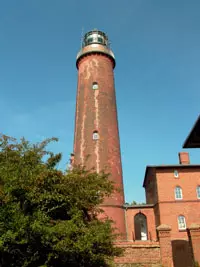 Prerow
A walk to Darßer Ort offers routes of varying lengths. The northwesternmost point of the Darß is dominated by its 35-metre-high lighthouse, whose viewing platform offers sweeping views across the Baltic Sea and the unique surrounding landscape. Year after year, you can watch the coastline change from here: new land is forming at Darßer Ort! But just a few hundred metres farther south, visitors see the opposite: beech and spruce trees decades old are being claimed by the water, literally having the ground pulled from beneath their roots—a ghostly sight!
Those with enough stamina can take the boardwalk loop towards Darßer Ort and then continue south along the beach to the beach trees. The return route to Prerow through the forest calls for caution and a basic knowledge of the trails. It is no coincidence that the Darß forest is known as the primeval forest of the Darß. Hikers may unexpectedly come upon paths that end in a swamp. And traces of Sus scrofa, the European wild boar, can be seen everywhere. There are no “raked” paths in the nature reserve either, so caution is required at all times.
Rainer Höll
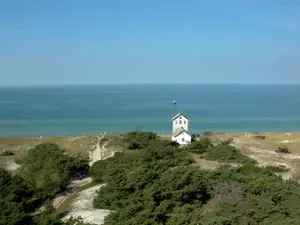 Blick vom Leuchtturm Darßer Ort (Foto: Rainer Höll)
