
Ahrenshoop
Ahrenshoop brings together an artistic heritage and a distinctive coastal setting: this Baltic Sea resort lies between the open sea and the Bodden lagoon, where Fischland meets the Darß. A visit can combine the art museum and the historic Kunstkaten gallery with a walk along the Hohes Ufer cliffs.
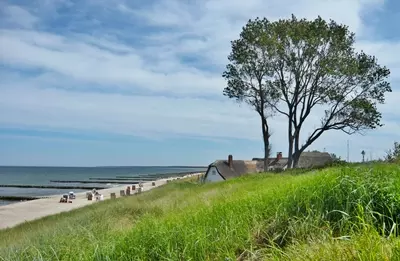 Ostseebad Ahrenshoop
Photo: © Wikimedia / Nikater gemeinfrei
Ahrenshoop at a glance
- Municipality: The seaside resort comprises Ahrenshoop, Althagen and Niehagen; Ahrenshoop itself lies directly on the Baltic coast.
- Art museum: Weg zum Hohen Ufer 36; its collection focuses on art from the Baltic coast dating from the late 19th and 20th centuries.
- Kunstkaten: Strandweg 1; this exhibition venue opened in 1909 and connects the artists’ colony with changing contemporary exhibitions.
- Coastal trail: The walking trail along the Hohes Ufer follows the cliffs south of Ahrenshoop to Wustrow.
- Bus: Route 210 connects Ribnitz-Damgarten West with Ahrenshoop and other places on the peninsula via Wustrow.
Artists’ colony and art venues
The artists’ colony emerged in the late 19th century, when painters discovered the landscape and the special light over the sea and Bodden lagoon as a place to work. The coast was more than just a backdrop: beaches, dunes, meadows and coastal woodland shaped the subjects, while the sea itself was not always the main focus of a painting. A visit to the art museum helps distinguish the different generations and styles, rather than reducing Ahrenshoop’s art history to a handful of familiar names.
The Ahrenshoop Art Museum opened in 2013 and displays a collection of almost 1,000 works from the late 19th and 20th centuries. Alongside works by Elisabeth von Eicken, Anna Gerresheim and César Klein, the program includes changing presentations from the collection and special exhibitions. The building by Staab Architekten draws on elements of regional architecture and reinterprets them in a contemporary form. The museum makes a good starting point for a visit: its galleries place the artists’ colony in the broader context of art along the Baltic coast.
The Kunstkaten at Strandweg 1 offers a second focus. This thatched building with its striking blue façade opened as an exhibition venue in 1909 and is considered one of northern Germany’s oldest galleries. Today, it presents year-round changing exhibitions on nature, landscape, the sea and people, bringing historical works into dialogue with contemporary art. If you can visit only one venue, choose the art museum for its larger collection or the Kunstkaten for its historic building and current exhibition program. The two venues have distinct profiles.
Walking along the Hohes Ufer
The Hohes Ufer is a stretch of cliff south of the village that extends to Wustrow. The walking trail runs close to the cliff edge, and viewpoints open up vistas across the Baltic Sea, the beach and the changing coastal vegetation. The landscape is geologically active: wind and waves reshape the cliffs, so the view today should not be thought of as an unchanging landscape. Stay on marked paths and keep your distance from the edge.
The art trail links the landscape with art history: one stop along the Hohes Ufer commemorates Hugo Jaeckel and his depiction of the cliffs. Here, you can see why the light and the transition between dunes, plants and sea mattered to the colony’s painters. The trail makes a short addition to a museum visit; sturdy footwear is advisable for the longer stretch along the cliffs. The municipality also offers guided walks that bring together art venues, coastal views and the lives of artists today.
Villages, Bodden lagoon and getting there
In addition to the coastal village of Ahrenshoop, the municipality includes Althagen and Niehagen. Its territory therefore stretches from the Baltic beach to the Bodden lagoon, with the peninsula’s character shifting over a short distance from open sea to reed-fringed shores and harbor scenery. Althagen is home to the Bodden harbor, while the center of Ahrenshoop, with its art venues, beach and cliffs, is the main visitor hub. If you combine art with a coastal walk, you can start the day in the village and then continue south toward Wustrow along the natural landscape.
If you’re traveling without a car, Ribnitz-Damgarten West is an important transfer point. Bus route 210 departs from right outside the station and travels via Wustrow to Ahrenshoop, continuing to places such as Born, Prerow, Zingst and Barth. For accommodation, the Ahrenshoop Mitte stop near the tourist information office is a convenient landmark; other parts of the municipality have their own stops. The bus route makes it possible to travel between places on the peninsula in stages, without having to make a round trip from the same starting point each time.
Fischland continues with Wustrow, whose pier and Bodden harbor give it a different character from Ahrenshoop’s cliffs. Farther north, Born lies on the Bodstedter Bodden and at the edge of the Darß Forest. If you’re looking for a starting point on the peninsula, consider Dierhagen with its villages along the beach and Bodden lagoon; on the Darß, Wieck is a good base for walks along the Bodstedter Bodden.
An overnight stay in Ahrenshoop is especially convenient if you want to visit the art venues and coastal trail without making the journey each day. For a longer trip, you can pair your stay with a second stop on Fischland, combining Ahrenshoop’s art museum and cliffs with the Bodden harbor or beach trails in neighboring villages.
Frequently asked questions about Ahrenshoop
What is the difference between the art museum and the Kunstkaten?
The art museum displays a collection of almost 1,000 works on Baltic coastal art from the late 19th and 20th centuries, as well as changing exhibitions. The Kunstkaten is a historic exhibition venue that opened in 1909 and has its own changing program.
Can you walk along the Hohes Ufer?
Yes. A walking trail follows the cliff section between Ahrenshoop and Wustrow, with views of the Baltic Sea. Natural erosion changes the coastline, so stay on the marked trail and keep your distance from the edge.
How do you get there by public transport?
At Ribnitz-Damgarten West station, you can catch bus route 210. It travels via Wustrow to Ahrenshoop; the best stop depends on where your accommodation or destination is located.
