
History
The Baltic coast and its hinterland are among the most popular holiday regions, and the countries bordering the Baltic Sea have much more to offer than exceptionally varied natural landscapes. The history of the Baltic Sea and its neighboring countries also holds many treasures that are of great interest to visitors to the region. How did Swedish granite reach Usedom? How can the place names along the Baltic coast be explained? The Baltic Sea has not only divided peoples; above all, it has been and remains a unifying element for the peoples who have settled along its shores and the cultures that have flourished there. The Danes and Swedes tried to gain a lasting foothold on the southern shore of the Baltic Sea, while Slavs and Germans settled together along the long Baltic coast between Holstein and Pomerania. All these efforts have left traces, some of which are still visible today or live on in local traditions.
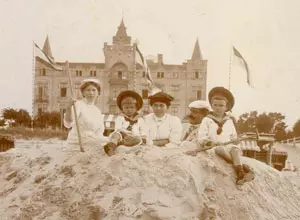 Historie (Foto: Hermann Sonntag/Sammlung Matthias Gründling)
Photo: © Hermann Sontag, Sammlung Matthias Gründling
Historie (Foto: Hermann Sonntag/Sammlung Matthias Gründling)
Photo: © Hermann Sontag, Sammlung Matthias Gründling
Modern times brought forth an entirely new economic sector, one closely connected with the waters of the Baltic Sea. In 1793, Germany’s first seaside resort was established in Heiligendamm near Rostock, launching an industry that has since become the dominant economic sector in many Baltic regions. Naturally, this went hand in hand with the development of bathing culture at seaside resorts, a new part of human customs and traditions. The new global trend of health and wellness tourism, combining traditional “wellness” services with taking personal responsibility for one’s health, has also emerged primarily in coastal regions, not least around the Baltic Sea, and is here to stay.
New permanent connections across the Baltic Sea have been built. In the 1970s, the six-kilometer-long Öland Bridge was the longest in Europe; it has long since been surpassed by bridges spanning the Great Belt, the Øresund and the Gulf of Finland. A tunnel between the islands of Fehmarn and Lolland is already under construction.
