
The Peene – Amazon of the North
The thin blue squiggle of the Peene River barely catches the eye when looking at a map. “The landscape of the ancient glacial valley, on the other hand, certainly does,” says Captain Johann Magner, intrigued. He once sailed the Peene aboard cargo ships operated by Deutsche Binnenreederei. Later, he transferred to the inland cruise ship “Königstein”, which was subsequently taken over by Deilmann shipping company.
A sparsely populated paradise
Between its mouth east of the Western Pomeranian town of Anklam and Malchin on Lake Kummerow, the longest river in the northeastern state—stretching for more than 100 kilometers—is navigable. It is also considered the most idyllic waterway in northern Germany. The flora and fauna along this border river between the regions of Mecklenburg and Pomerania are exceptional and protected. An unspoiled, sparsely populated paradise.
A Peene giant, tailor-made
At 68.50 meters long, 8.20 meters wide and with a draft of just 1.40 meters, the “Königstein” is tailor-made for the river. “Where it gets too narrow, you can’t afford to make mistakes,” Magner says with a wink.
Coming from Rügen, the handsome white 850-ton “steamer” calls at the port town of Wolgast. The town lies on the Peenestrom, a lake-like expanse between the Achterwasser lagoon on Usedom to the west and the Szczecin Lagoon to the east.
The drawbridge raises its blue arms toward the summer sky: the liner has a clear passage, much admired and photographed.
Three leisurely hours across the river-lake, with steep banks alternating with stretches of fields, woods and meadows. “This peaceful waterscape has a calming effect on us—it’s truly relaxing.” A couple from Wismar lounge contentedly in their deck chairs on the spacious upper deck, with its panoramic views. “We gave ourselves this trip for our golden wedding anniversary, because we grew up by the Peene.” Another 63 passengers—there can be 74 at most—from all over Germany are enjoying the river cruise. They stay in tastefully and functionally furnished outside cabins with all the comforts of a cruise ship.
Plenty of water beneath the keel
Beyond the Zecherin Bridge, which connects Usedom to the Western Pomeranian mainland, the Peene River shimmers silver. The passage through Anklam calls for concentration. The open railway bridge on the Berlin–Stralsund line leaves barely a meter of “wiggle room” on either side. “No problem with 2 x 280 horsepower and a bow thruster,” Captain Magner says dismissively, leaning back in his “pilot’s chair” during the tense maneuver. For safety, helmsman Milan tells everyone to duck.
“We have plenty of water under the keel,” Magner reassures the skeptics. “The river’s natural depth is between three and four meters, and over 100 kilometers it drops by just 28 centimeters. Because the current is so weak, we can travel upstream at 12 knots.” For many, the pleasures of taking things slowly are a new discovery. Depending on the wind, the water even flows against its usual direction. The echo sounder remains on as a precaution.
Caution: beaver crossing!
There’s a stir as a beaver crosses the river just ahead of the ship. The animals were released into the wild here and quickly made themselves at home. Herons glide silently along the reed beds. Deer pause while grazing or bound away in elegant leaps.
Johann Magner picks his way through the river’s sharply curving bends. Suddenly, a voice calls from the reeds: “What a monster of a boat!” “It’s about to get even longer!” someone quickly shouts back.
Soon the late-Romanesque tower of St. Bartholomew’s Church rises above the green expanse, heralding the thriving Hanseatic town of Demmin. “The little rivers Trebel and Tollense flow into the Peene here, giving the area its name, ‘Land of Three Rivers’. Shipping was busy here from the Hanseatic era onward, and the first steamer from Szczecin arrived in 1855. The grain warehouses at the harbor are a visible reminder of the lively trade,” the tour guide explains.
 Impressions of primeval forest
A chicken yard erupts into chaos. The hens flap about frantically. The roosters try in vain to restore order to their flock with their crowing. The ducks notice the unfamiliar behemoth only at the last moment and take flight.
Then it gets even tighter. The MS “Königstein” almost completely fills the narrow riverbed, and as it rounds bends, its stern nearly brushes the reeds. Their flexible stalks bend respectfully aside under the wash of water. Overhanging branches snap off and land on deck. “Flower picking is included,” jokes a woman from Rostock, while her friend from Sweden can hardly believe “that something so exotic still exists in Germany.” As if to prove the point, floating islands of grass and flowers drift toward the ship and are sliced apart by the bow: miniature Amazonian scenes. Even the temperatures are just right. A red kite circles above our heads. Then we enter the eleven-kilometer-long Lake Kummerow and the start of Mecklenburg Switzerland, a landscape of hills and lakes.
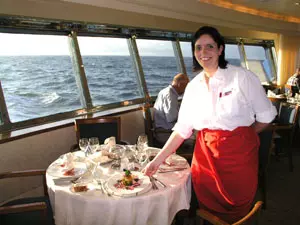
The evening winds down with the Captain’s Dinner and a glass—or several—of wine on the upper deck. The sun sinks below the horizon behind the rolling Bornitz hills, a glowing red ball. Later, the gentle moonlight makes the eleven-kilometer-long lake seem even more romantic. Wisps of mist drift across the water. Images by Caspar David Friedrich come to mind. “Hier bliwt allens bi’n ollen!” (“Here, everything stays as it always was!”), declared Mecklenburg-born writer Fritz Reuter. And thank goodness for that!
Text and photos: Peer Schmidt-Walther (1), Deilmann Shipping Company (1)
More cruise stories by the author in CRUISE EXPERIENCES Stories from six continents. Only €5, including shipping!
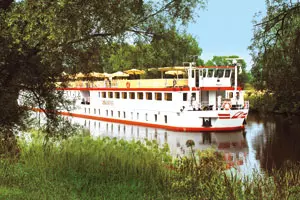 Die 'Königstein' (Foto: Peter Deilmann Reederei)
