
The Oder, Peene and around Rügen aboard the “Swiss Coral”
Nature at its finest, with pheasant’s-eye flowers
The Oder floodplain is crisscrossed by numerous old river channels. Nowhere else in Europe have such vast natural floodplains been preserved. Together, these areas form an enormous retention basin where floodwaters can spread out without causing damage downstream. Renaturalization, left to its own devices, has achieved remarkable things: it has created one of Germany’s most species-rich habitats. These include floodplain forests, near-natural mixed broadleaf forests, and the northwesternmost range of the steppe zone, where blue-blooming cross gentian, silvery feather grass and yellow pheasant’s-eye flowers grow. The exceptionally rich waterbird life has been placed under international protection. More than 120 bird species breed in the national park, including white-tailed eagles, ospreys and lesser spotted eagles, many white storks, the rare black stork, as well as the globally endangered sedge warbler and corncrake.
Szczecin, capital of the West Pomeranian Voivodeship
Beside the towering ocean-going cargo ships in Szczecin harbor, our liner looks like a toy. But the harbormaster assigns his longtime colleague Magner the most attractive berth: right in front of the famous Hook Terrace, where large cruise ships also dock. The next day, the beautifully restored medieval old town, the Pomeranian dukes’ castle and their sarcophagi, the rusty-red brick Old Town Hall, the less favorably reconstructed Gothic Cathedral of St. James, and last but not least the Maritime Museum all prove irresistible, drawing everyone ashore for a few hours of sightseeing.
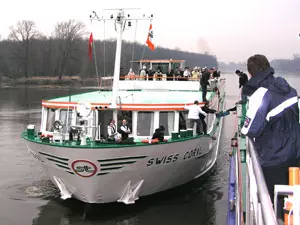 Reunited, with a sense of freedom
Beyond Szczecin, the river widens into an estuary. Even a reunion takes place: the East and West Oder meet near Lake Dąbie. Ahead, the view opens onto the Oder Lagoon, dotted with lighthouses. We leave the Great Kaiserfahrt, which leads to Świnoujście on the Baltic Sea, to starboard and turn into the Small Lagoon. As we have lunch abeam of Ueckermünde, we begin to feel at sea. One passenger remarks: “I think I’m sitting in the water!” Waves lap against the low-set restaurant windows.
To starboard, the island of Usedom glides past, with its once again fashionable seaside resorts on the coast. Heringsdorf, Bansin, Ahlbeck and Zinnowitz—once known as “Berlin’s bathtub” before the last war—are naturally on the itinerary for the coach excursions from Wolgast. The day ends in festive style with the captain’s dinner in the harbor of the former residence of the dukes of Pomerania-Wolgast. The chef and his colleague conjure up culinary highlights in the tiny galley at the bow.
Submarine, rockets, party bosses and locomotive whistles
“The blue wonder is opening up—let’s get going!” Magner says as he starts the engines in sight of the drawbridge between Wolgast and Usedom. He carefully threads his “steamer” through the bottleneck. Ahead is a dark-gray tube with a slender conning tower. Decommissioned by the Russian Navy, the world’s once-largest diesel-powered submarine, weighing 4,000 tons, now serves as a visitor attraction in Peenemünde harbor. Otherwise, this is where Wernher von Braun comes to mind. The village on the north of the island made world history when the first “V-2” rockets were launched from the research center in 1942—a foundation for later crewed spaceflight. In the postwar years, the center of German rocket research became a naval base for the former East German People’s Navy. Since reunification, however, its dilapidated buildings have become a much-visited museum, displaying rockets, aircraft and an NVA corvette.
We make the crossing over Greifswald Bay, its surface flecked with whitecaps, toward Rügen. Saltwater spray washes over the foredeck. “Once, a wing even sailed right across the room,” Magner recalls rougher days and seasick passengers, as Vilm, once a favored island retreat of prominent SED figures, appears to port. “It used to be the party bosses who protected this little paradise unintentionally; now it’s the nature conservation association,” Magner says, “with the difference that guided tours are allowed now.” As if in confirmation and welcome, the “Racing Roland” whistles in Lauterbach harbor in southern Rügen. The steam-powered narrow-gauge train screeches to a halt opposite the “Swiss Coral’s” berth.
Rat race and a protected historic district
A cloudless sky promises perfect travel weather for the cruise around southern Rügen, through the scenic narrow passage of the Strelasund. The venerable Hanseatic port city of Stralsund, now a UNESCO World Heritage Site, raises the towers of its three mighty brick churches above the harbor’s warehouse skyline just in time for breakfast. During departure, with a view of Stralsund’s “best side,” most guests are impressed by the work that has gone into rebuilding the city. Stralsund has more than 800 historic buildings. Half of them already shine with a new luster. The entire historic district has now been designated a UNESCO World Heritage Site.
Island fever beneath the lighthouse
Swans stand in the shallows beside the narrow shipping channel. The “Swiss Coral” trails its wake alongside like a train. Hiddensee—“dat söte Länneken,” as the locals call their “sweet little island”—first appears low, then hilly, to port, crowned by the lighthouse familiar from television, perched on the Dornbusch headland. The “Sylt of the Baltic” is by no means a sinfully expensive fashionable resort. Since 1930, it had been the holiday home of the island’s most prominent guest. Nobel Prize-winning author Gerhart Hauptmann, who traveled there by ship from Stralsund every time, wrote important works of world literature on the island. His house, “Seedorn,” in Kloster is now a much-visited museum.
Johann Magner brings the 82-meter-long “Swiss Coral” alongside the quay at Vitte with centimeter precision. Horse-drawn carriages are waiting there for an evening tour, since, fortunately, the 17-kilometer-long island is car-free. An alternative to a leisurely two-horse ride: rental bikes. We pedal along well-maintained paths through the idyllic north. Enddorn, with its dazzling white sandy spit, is a particularly special gem. “We don’t have skies this big back home!” marvels a woman from the Swiss Alps.
Off the bike—riding is not allowed here either—and on foot through the beautiful countryside! Hundreds of rare bird calls surprise and delight visitors to this natural paradise. When the moon rises and the lighthouse flashes into the evening sky, the romantic Caspar David Friedrich atmosphere is complete. First-time visitors to Hiddensee are “warned” that it can become addictive.
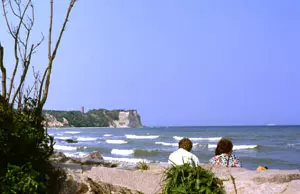 A crowned Caribbean
The poet Ernst Moritz Arndt already waxed lyrical about his homeland: “Oh, Rügen! Lovely island, to which love ever yearns...!” We cruise peacefully through the lagoon landscape. “Glaciers and meltwater caused the sea to overflow some 10,000 years ago, spilling into the shallow ground-moraine landscape,” Captain Magner explains from the bridge, bringing the coastal landscape’s shallow basins to life.
After around 440 kilometers, we reach the harbor at Breege on the Wittow peninsula: final stop, Cape Arkona! Germany’s northeasternmost point greets us with its two historic lighthouses atop a 46-meter-high marl cliff, tirelessly gnawed away by the surf. From this lofty vantage point, the view sweeps far across the Baltic Sea, where cargo ships trace foamy paths. It also takes in the ten-kilometer-long beach of the Schaabe spit, which evokes thoughts of the Caribbean. Beyond it, the white chalk cliffs of Stubbenkammer, framed by lush green beech forest, rise against the blue sky. The crowning glory is the 117-meter-high Königsstuhl. That evening, the coach excursionists will be talking about it, as well as the fishing village of Vitt, the princely residence at Putbus with its circus-shaped layout, and the Schinkel-designed lookout tower in the Granitz, with its view of the newly revived and popular seaside resort of Binz, where the “Arkona” sleeper train from Basel terminates.
Tired from so many impressions, we are lulled to sleep by the waves gently lapping against the hull. Hiddensee and Rügen fan Johann Magner says: “I’ve seen a lot, but this region is the most beautiful for me.”
Text and photos: Peer Schmidt-Walther
More cruise stories by the author in CRUISE EXPERIENCES Stories from six continents. Now only €5, including shipping!
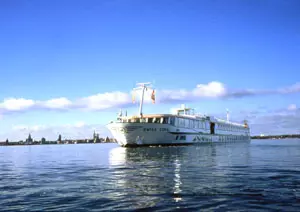 Die 'Swiss Coral' vor Stralsund (Foto: Peer Schmidt-Walther)
