
Wellness Hotels & Providers on Rügen
At over 900 sq km, Rügen is not only Germany’s largest island, but probably its best-known as well. The name Rügen is synonymous with a natural feature unique in Germany: the chalk cliffs in Jasmund National Park, between Sassnitz and Lohme, dominated by the 116-metre-high Königsstuhl. The chalk cliffs were already a subject for the painter Caspar David Friedrich, who came from Greifswald. Initially an attraction for their appearance alone, the cliffs soon revealed the health benefits of what is now known as Rügen healing chalk.
Rügen’s Baltic coast—stretching from the Schaabe isthmus in the north, along the eastern chain of seaside resorts from Prora through Binz, Sellin and Baabe to Göhren, and south to the Mönchgut peninsula, with its long beach between Lobbe and Thiessow—has become one of the Baltic Sea’s most popular holiday regions. Binz is the best-known of Rügen’s seaside resorts, both nationally and internationally. The island’s deeply indented Bodden coast in the south and west also offers a wide range of recreational opportunities. The combination of seawater, the Baltic Sea’s therapeutic climate and nearby coastal forests creates an ideal blend of health-promoting factors, prompting numerous wellness providers to set up here in particular. ; the painter Caspar David Friedrich
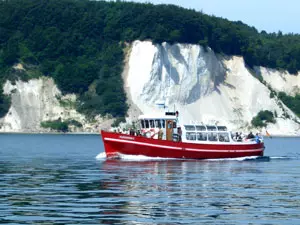 Rügener Kreideküste (Foto: Tourist Service Sassnitz)
