
Yachting and watersports on the Baltic Sea
Anyone travelling on the Baltic Sea in their own yacht or leisure boat should plan their route according to the sailing area, experience and boat: exposed coastline, sheltered fjords and Bodden lagoons each present different requirements. Draft, clearance heights and local berth allocation determine which harbours are within reach.
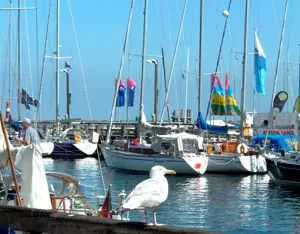 Yachting an der Ostsee (Foto: nordlicht verlag)
Yachting and watersports on the Baltic Sea: key facts
- Fjords and Bodden lagoons are sheltered sailing areas, but that does not automatically make them hazard-free; wind, visibility and local channels remain important.
- Conditions on the open coast can change quickly with the weather and sea state. A voyage requires suitable equipment, experience and up-to-date navigation information.
- If you want to get out on the water without your own boat, find other options under Watersports on the Baltic Sea and canoe touring.
Choose a sailing area to suit your trip
Kiel Fjord and the fjords farther north connect coastal towns, harbours and the open Baltic Sea. They are well suited to planning a voyage with clear stages and accessible harbours; entrances and exits, commercial shipping and local guidance should all be factored into chart and weather planning. Accommodation and places to stay in Kiel can help you plan a stop on land at the western gateway to the Baltic Sea.
Farther east, the landscape is shaped more by islands, Bodden lagoons and sheltered bays. Between the Darß peninsula, Rügen and the mainland, exposed coastal stretches alternate with shallower, narrower channels. This can make shorter legs possible, but calls for careful attention to draft, shoals and marked fairways. Barth on the Bodden is a good starting point if you are planning a stay on the southern Bodden coast; for a stop on Rügen, consider Sassnitz.
On Usedom, the Achterwasser lagoon and the Peenestrom contrast with the exposed outer coast. Choosing a sailing area should therefore involve more than distance alone: check water levels, bridge and clearance heights, draft and weather windows locally. If you are combining your route with a land-based holiday, compare stays in Zinnowitz or at the Kaiserbad resort of Heringsdorf.
Your own boat, chartering and the right support
With your own boat, the crew and skipper determine the range, daily distances and equipment. For a charter, handover, briefing, return time and the equipment included in the agreement all form part of planning the specific voyage; these factors help determine whether a multi-day route or a shorter outing fits your travel plans. Choose a boat to suit the sailing area and the crew’s experience, rather than relying on any blanket claim about suitability.
The type of boat also affects your plans. Sailing yachts need enough room to tack and manoeuvre; for motorboats, fuel consumption, range and berth availability matter. Small human-powered boats call for different decisions about distance and weather. The page Yacht harbours on the Baltic Sea covers choosing a berth and the differences between individual harbours.
Plan safely before setting off
Before every voyage, consider the weather forecast, wind direction and strength, visibility, sea state and official warnings together. Nautical charts or current electronic charts, position-finding equipment, communication devices and safety equipment must be appropriate for the boat and crew. Advice from people familiar with the area can add information about local conditions, but it does not replace navigation or your own responsibility on board.
Guest berths are not allocated in the same way everywhere: Sporthafen Kiel notes that harbourmasters assign berths on site; for Warnemünde, the City of Rostock states that guest berths cannot be reserved. At the southern berths for leisure craft in the Alter Strom, the Bahnhofbrücke limits passage to boats no more than 1.80 metres high above the waterline. Differences like these make an alternative route and suitable boat height specific points to consider when planning. More harbour examples are available in the overview of yacht harbours on the Baltic Sea.
The Baltic Sea offers many different ways to spend time on the water. A suitable route takes shape when the sailing area and boat match the crew’s experience, daily destinations remain realistic and current conditions are checked again before setting off.
Frequently asked questions about yachts on the Baltic Sea
Is a sheltered bay always suitable for beginners?
No. Protection from swell does not indicate whether the channel, draft, weather, traffic or manoeuvres are suitable for the crew’s experience. Conditions must be checked for the specific route.
What should be included in route planning for a charter voyage?
The departure harbour, return time and agreed equipment determine whether a short outing or a multi-day voyage is a better fit. The example harbours also show that guest berths cannot be reserved everywhere and that some entrances impose a specific limit on boat height.
Can I be sure of reserving a guest berth in advance?
At Sporthafen Kiel, harbourmasters assign guest berths on site. The City of Rostock does not take reservations for the guest berths in Warnemünde managed by the harbourmaster.
