
Discover Perlin: Village History and Places of Remembrance
Accommodation in Perlin
Perlin’s village history comes to life through tangible evidence: historic homes, the village church, and several places of remembrance each offer a different perspective. Visitors interested in architecture and local heritage will find a clear thematic thread here. A rest area and an excursion add opportunities to get your bearings outdoors alongside these cultural themes; the landscape of the wider destination of Northwest Mecklenburg provides a broader setting.
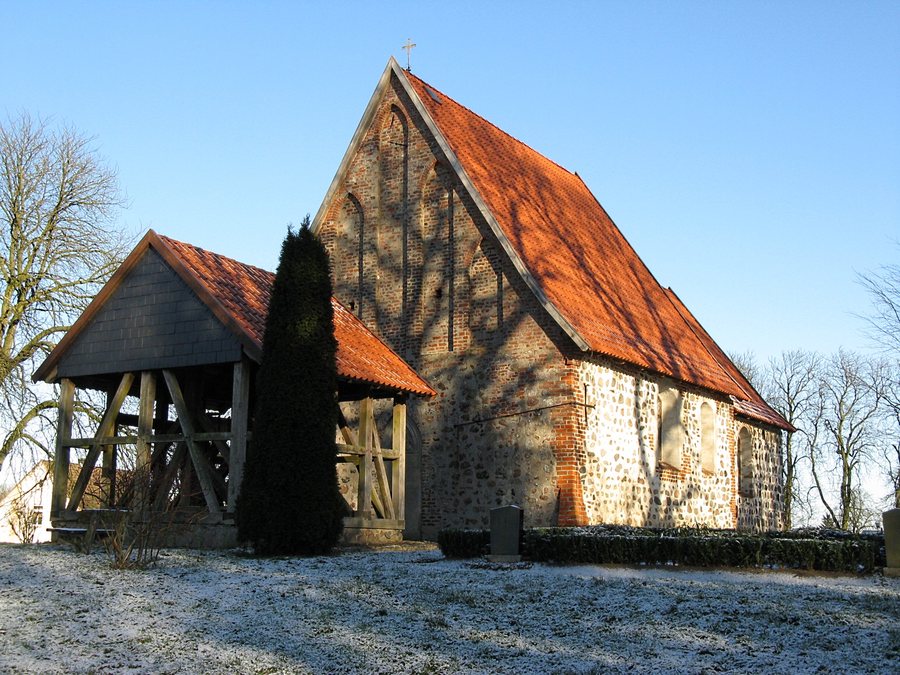
Houses and the Village Church
Perlin’s sights include the former parsonage and the former coachman’s house. Numerous well-preserved thatched cottages shape the village’s appearance; the former forester’s house is also well preserved. The thatched houses offer a different architectural perspective from the former parsonage, coachman’s house, and forester’s house. A plaque commemorating Heinrich Seidel is attached to the former parsonage at Am Friedhof 2. The district’s list of historic monuments dated February 28, 2025, includes the building with this plaque.
The village church has a freestanding bell tower containing a bronze bell cast in Lübeck in 1735. The cemetery adjoins the church; a small brick-built burial chapel stands there. Behind the chapel is a family burial site of the Counts of Bassewitz. The churchyard is also home to the grave of Inspector F. Anders, with a tomb and enclosure. The bell, chapel, and burial sites are distinct tangible landmarks around the church and cemetery.
Heinrich Seidel and Places of Remembrance
Heinrich Seidel was born in Perlin on June 25, 1842. A stele opposite the church, by the village pond, commemorates him. The plaque on the former parsonage is also dedicated to him. His birth, the stele, and the plaque provide several local points of reference for remembering Seidel: his life story begins in Perlin, while the two memorials stand in different locations in the village.
Rest Area and Excursion
A rest area was created in 2010 on the open space by the community center, with imaginative design by sculptor Nando Kallweit from Badow. The “Around Lake Dümmer” excursion offers a different way to explore the area: after 3.6 kilometers, it reaches Perlin. The route follows paved roads and paths with little traffic. In some places, there is a separate cycle path beside the country road; the route also has gentle to moderate inclines.
In the area around Perlin is a group of two very well-preserved Bronze Age burial mounds. A 700-meter-long, tree-lined farm track runs alongside the group. Access may vary depending on field conditions. The burial mounds therefore form a distinct archaeological point of interest in the surrounding area, separate from the architectural and memorial sites in Perlin itself.
Northwest Mecklenburg as a Broader Setting
As a wider travel destination, Northwest Mecklenburg features varied landscapes: in the north, it encompasses the “Northwest Mecklenburg Hills with Wismar Bay,” and in the south, the “West Mecklenburg Lake District with Lake Schwerin.” Terminal moraine ridges, gently undulating ground moraine plateaus, steep and flat stretches of coast, meltwater and drainage channels, and outwash plains shape the district’s landscape.
Gadebusch Castle, a Renaissance castle dating from 1573 in Gadebusch, is part of the district’s cultural heritage. It is considered a rare example of Mecklenburg or North German Brick Gothic Renaissance architecture and features reliefs in the regional Johann Albrecht style. The “Radegast Valley” landscape conservation area offers a different natural highlight: it covers about 600 hectares between the southern edge of Rehna and Lake Nedder near Gadebusch. It includes the Radegast’s strongly meandering, natural course, as well as adjacent grassland, reed beds, wooded areas, and wet woodland.
Discover more destinations: Pokrent, Grambow, Zickhusen, Alt Meteln, Klein Trebbow, Schildetal, Brüsewitz, Dalberg-Wendelstorf.
See the broader travel overview: Amt Lützow-Lübstorf.

