
Grabiny-Zameczek: Castle Remains, Park and Trails
Accommodation in Grabiny-Zameczek
A chapel in a former journeymen’s room and the remains of a Teutonic castle give Grabiny-Zameczek a distinct historical character. There is also a park with notable tree species and destinations along the Motławski Trail. When planning your trip, it is worth distinguishing between the architectural heritage in the village, the nearby natural attraction and the longer regional trail.
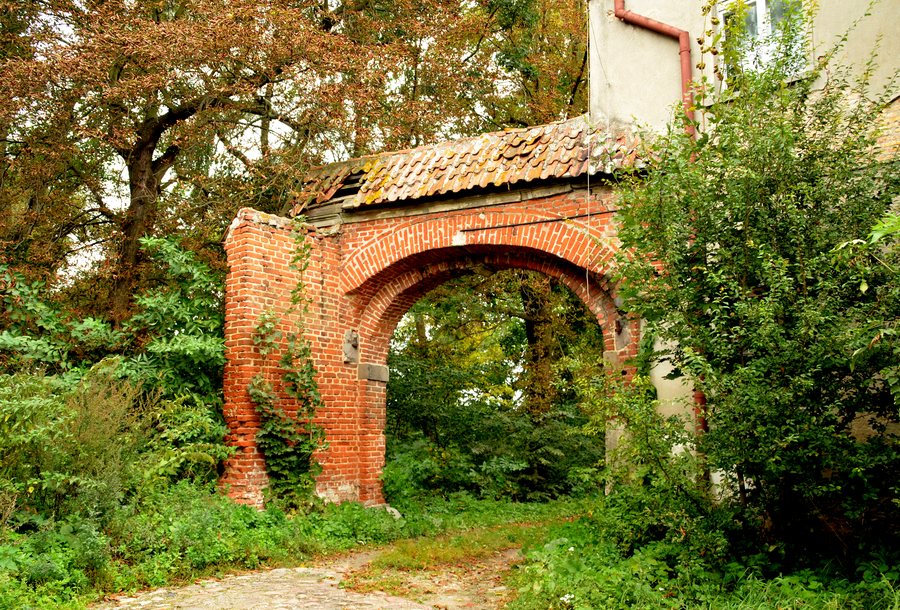 File:Grabiny ZAMECZEK -Brama z herbem Gdańsk.jpg
Photo: Wiesława Nowakowska via Wikimedia Commons, CC BY-SA 4.0
Architectural History and Local Highlights
A former journeymen’s room in a farm building serves as a chapel in Grabiny-Zameczek; it is dedicated to the Holy Trinity. The room thus brings together two clearly distinct aspects: its former function within a farm building and its current use as a chapel. If you are interested in the architectural and cultural history of the village, this combination is a particularly striking point of reference.
The complex’s brick gate bears a stone coat of arms of Gdańsk. The combination of materials—brick on the gate and stone for the coat of arms—gives the entrance a distinctive architectural detail. The remains of a Teutonic castle in Grabiny-Zameczek are an attraction along the Motławski Trail. In this way, an architectural detail and historic castle remains add to the village’s cultural heritage in different ways.
An unpaved access path leads from Młyńska Street to a wooden building that formerly housed a school and a mill. Its former uses distinguish this building from the chapel and castle: here, the focus is on the functions of a wooden building. If you want to understand the village’s history through more than religious and fortified buildings, this wooden structure adds a perspective on its former educational and milling uses.
Park, Natural Attraction and Regional Trail
Several London plane trees and red-leaved beeches grow in the complex’s park. These tree species provide a distinctive natural feature alongside the historic buildings. A large rest area is also located near the park in Grabiny-Zameczek. The park is therefore a point of reference both for natural features and for finding your way around the nearby area.
A marked, 500 m access path leads from the Motławski Trail in Grabiny-Zameczek to Batorowy Ostaniec. At 14.6 m above sea level, it is the highest natural point in Żuławy Wiślane. This natural destination adds a regional landscape perspective to the historic buildings. For planning, the path length and elevation are two different points of reference: the connection to the destination and its standing within Żuławy Wiślane.
Further afield in the region, the red-marked Motławski Trail runs between Gdańsk (Urząd Marszałkowski) and Tczew; it is 40.4 km long. The 500 m access path and the 40.4 km trail represent different scales of planning: access to a single natural destination versus a regional route between two endpoints. This allows you to distinguish the access path from the longer tour. Check trail conditions before setting out.
Along the Motławski Trail, the wider area is home to brick churches dating from the period of the Teutonic Order: in Wróblewo, Krzywe Koło, Suchy Dąb and Koźliny. These places extend the cultural perspective beyond Grabiny-Zameczek and form part of the trail’s regional route. If you want to explore historic architecture not just in one place but along a route, the four churches form a distinct comparison group: the same building material and historical period, but in four different named locations.
Discover more destinations: Miłowo, Pręgowo Górne, Gdańsk, Warcz, Cedry Wielkie, Pszczółki, Koszwaly, Przejazdowo.
Go to the main travel overview: Gdańsk.

