
Vitaby: Mill, Church and Railway History
Accommodation in Vitaby
Vitaby combines a medieval-style church and a long railway history with a rural setting; just outside the village lies the old Krubbemölla watermill on the Mölleån. This makes the area interesting for travellers who want to discover traces of history in the church, settlement and landscape. When choosing where to stay, you can consider whether local history, the heritage railway or the surrounding landscape should be the focus of your trip.
Church and settlement history
Vitaby Church retains a distinct medieval character. Inside is a triumphal cross from the early 13th century. The settlement around the church consists of two farmsteads and the old school. The church building, its furnishings and the settlement offer different points of interest for a culturally focused stay. If you are interested in these connections, you can consider these features together: the cross points to the history of the church, while the farmsteads and school shape the settlement.
The Haväng–Vitemölla cultural-historical environment, designated as being of national cultural-historical interest, includes the parish of Vitaby and reflects settlement continuity from the Stone Age to 1940. This makes it possible to place the parish’s history in a long-term context, while the church and its furnishings offer a concrete connection to the place.
Krubbemölla and the Vitaby Market
The path to the mill runs from Vitaby’s sports ground along Möllestigen. This lets you connect the history of the mill with a named route. The route leads to a historic destination mentioned in written records as far back as the 17th century.
The Vitaby Market was first held in the village square in 1910 and takes place every year on a day in May. If you want to plan your trip around the market, check the exact date in advance.
Railway and getting around
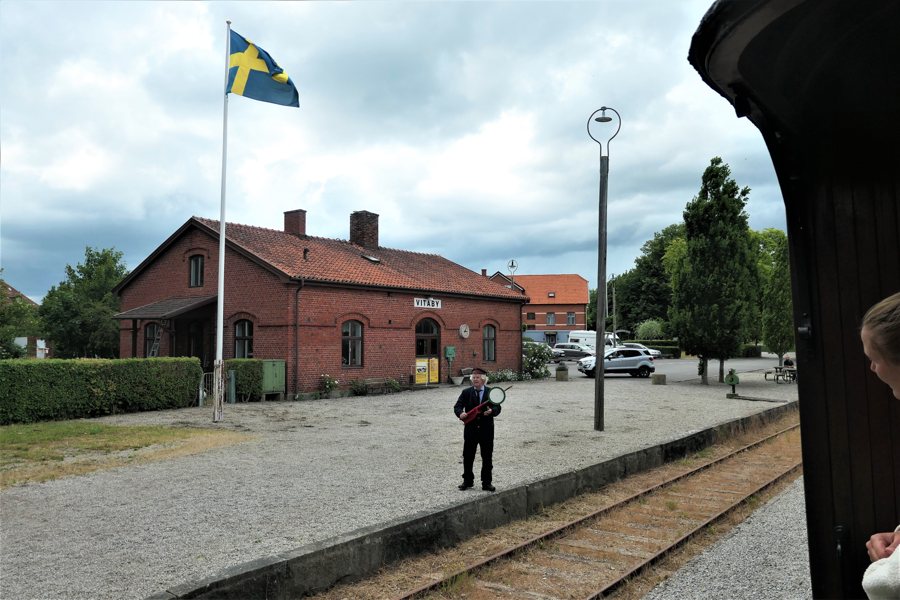
The station’s history also has a precise date: the first steam train stopped at Vitaby railway station on 18 September 1901. The station settlement began to develop around the turn of the 20th century. Heritage trains run on the 13.4-kilometre Brösarp–Ravlundabro–Vitaby–Sankt Olof section of the Österlen Railway. The Skånska Järnvägar heritage railway association preserves and continues to develop the line. The first steam train and today’s heritage railway section represent two different periods in the history of the railway. For a specific trip, it is worth checking the timetable.
Bus services run from Vitaby to Brösarp in the north and Simrishamn in the south. This provides a north–south orientation for journeys from the village; check the timetable before you travel.
The landscape around Vitaby
The surrounding area consists of agricultural land with pastures, copses and scrubland. West of Vitaby, the landscape is characterised by large, unspoilt coniferous forests. Torups ängar is a forest reserve near Vitaby, outside Simrishamn. You can therefore distinguish between the agricultural land, the forest landscape to the west and the named forest reserve when the landscape is an important factor in choosing where to stay.
Discover more destinations: Kivik, Borrby, Rörum, Simrishamn, Brantevik, Gladsax, Hammenhög, Gärsnäs.
Return to the main travel guide: Simrishamn.

