
Uzdowo – Grunwald Monument and Hiking Trail
Accommodation in Uzdowo
Uzdowo combines a clearly dated historical turning point with a hiking trail whose proposed route includes the town. The Grunwald Monument was erected in 1931 and destroyed in 1939; the Grunwald Hiking Trail is a proposed route through several towns. This gives you a concrete choice when selecting a destination: local history or active route planning. If you are looking for accommodation, you can first consider which of these two focuses you want to shape your stay.
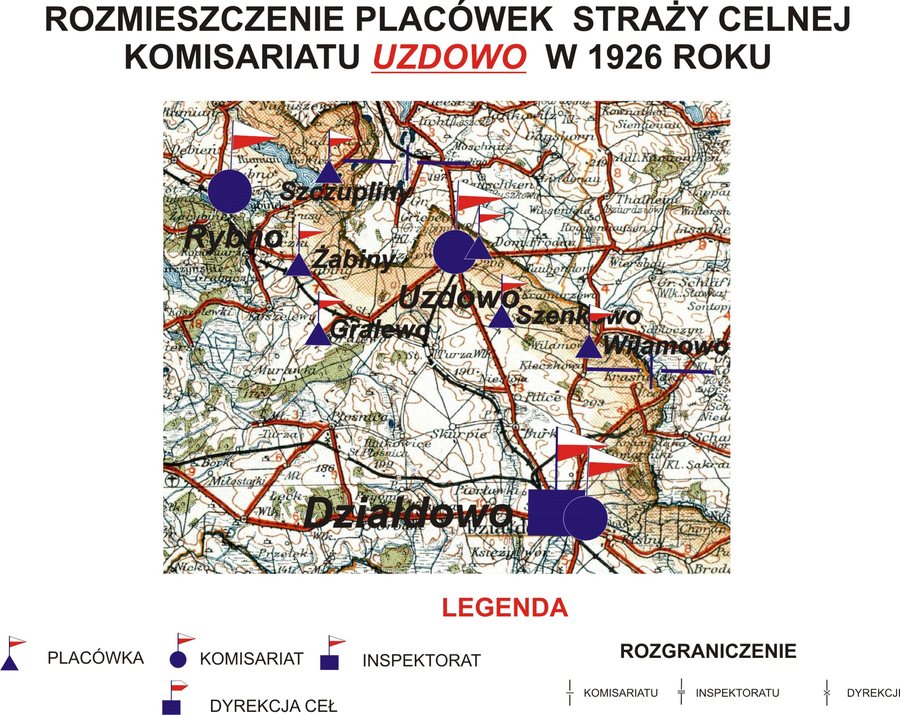 File:Uzdowo komisariat SC 1926.jpg
Photo: WIG,Ar. 44 - 1933; Mapa ze znakami SC - Gruzin via Wikimedia Commons, Public domain
The Grunwald Monument in Uzdowo
The Grunwald Monument in Uzdowo was erected in 1931 and blown up by the Germans in the first days of the Second World War, in 1939. The two dates mark different phases: it was erected before the war and destroyed at its outset. Visitors interested in local history will find a specific point of reference in time. The monument’s history offers a different approach to travel planning than a hiking route: here, the focus is on its erection and destruction, not on a series of trail stops.
The Grunwald Hiking Trail as a route perspective
The Grunwald Hiking Trail is a red route prepared by the Warmińsko–Mazurski Oddział PTTK. The proposed route passes through Grunwald, Leszcz, Grzybiny, Uzdowo, Myślęta, Turza Wielka, Skurpie, Wysoka, Prioma, Płośnica, Turza Mała, Koty, Jeleń, Wąpiersk, Ciechanówko, Chełsty, Kurojady, Lidzbark, Bryńsk and Bądzyn. Uzdowo is therefore part of a proposed route that includes many towns. If you plan to take the hiking route, check its current course and trail conditions in advance. The two local themes can thus be clearly distinguished: the monument points to a dated local history, while the proposed route describes a hike through several towns.
Soldau: History and culture in Działdowo
Within the broader destination of Soldau, Działdowo offers a distinct focus on urban history and culture. The Interactive Museum of the Teutonic State opened in Działdowo Town Hall on August 13, 2013. The Interactive Exhibition of the Teutonic State spans two floors; the first consists of five rooms arranged in chronological order. The town hall in the center of the market square dates from 1796. The market square lies at the center of the old town and is laid out in a square; at the same time, the old town retains its original medieval street layout. These features give the town’s history both an architectural and a spatial context.
Another cultural venue in Działdowo is the Muzeum Pogranicza, a municipal cultural institution housed in Dom Duży, which was rebuilt and adapted for cultural purposes. Its permanent exhibition is titled “Działdowo – miasto i ludzie dawnego pogranicza”. The Teutonic Castle in Działdowo is part of the “Szlak Zamków Gotyckich” (Gothic Castles Trail). Visitors interested in different historical themes can consider urban history, a permanent exhibition and the connection to Gothic castles separately, rather than treating them as a single stop.
Działdowo’s sacred and commemorative history is another theme: the Sanctuary of the Blessed Martyrs is located in the Church of St. Catherine of Alexandria. It commemorates Archbishop Antoni Julian Nowowiejski and Bishop Leon Wetmański, who were martyrs at the Działdowo camp. The former barracks building is considered historically significant and a testament to the martyrdom of the Polish nation. The Działdowo Jarmark, featuring antiques, crafts and healthy food, offers a different cultural focus: a recurring gathering celebrating culture, craftsmanship and local creativity. If the Jarmark is important to your plans, check the latest event dates.
Discover more destinations: Lidzbark, Naguszewo, Rybno, Działdowo, Murawki, Nowa Wies, Grądy, Kopaniarze.
For the broader travel overview: Soldau.

