
Jeziorany: History and Cycling Routes
Accommodation in Jeziorany
In Jeziorany, you can plan your trip around three distinct interests: historic architectural remains in the town, two cycling routes that start and end in Jeziorany, or the nearby Ustnik Nature Reserve. Each of these themes has a different focus. The town’s architectural history spans from the Middle Ages to the early 20th century; the cycling routes differ in length and course. Ustnik, in turn, is dedicated to protecting waterbirds and marsh birds.
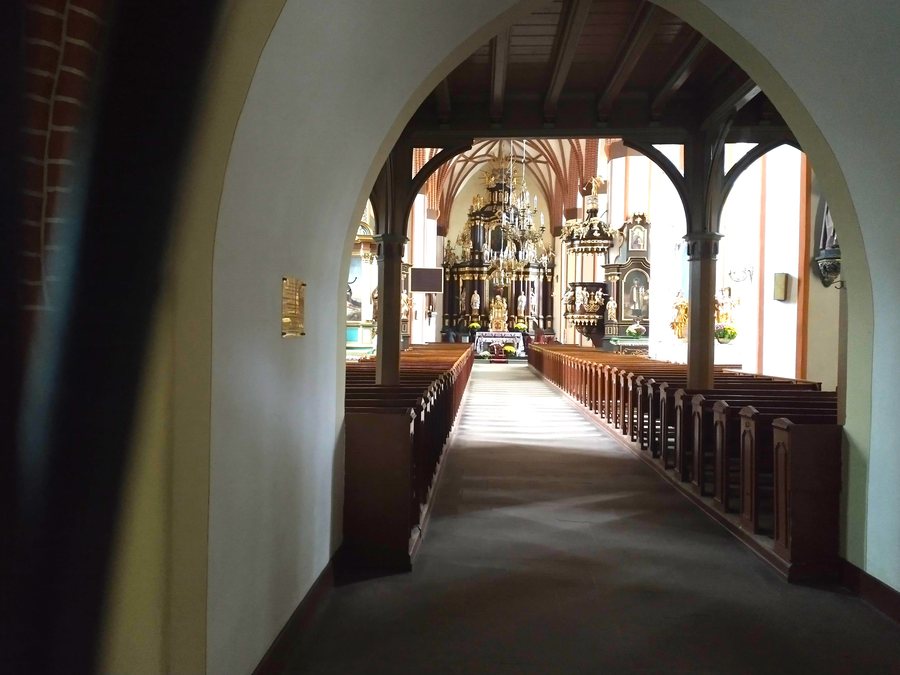 File:Saint Bartholomew church in Jeziorany (2).jpg
Photo: MOs810 via Wikimedia Commons, CC BY-SA 4.0
Historic architectural remains in Jeziorany
The surviving remains in Jeziorany include a Gothic castle dating from the second half of the 14th century, as well as remnants of the town walls. Together, they point to the town’s medieval architectural history. Other buildings date from considerably later periods: the Evangelical-Augsburg church was built in 1886–1887, and an Art Nouveau tenement building on Hanki-Sawickiej Street dates from 1909. Those interested in local history and architecture will find several clearly dated points of reference, though they do not all belong to the same period.
This chronological range helps you place the historical themes in the context of your trip: the castle and town-wall remains date from the Middle Ages, while the church and tenement building date from around the turn of the 20th century. The tenement building is also specifically identified by its location on Hanki-Sawickiej Street and its classification as an Art Nouveau building. These different details make the historic sites distinct from one another, rather than defining Jeziorany by a single building or period.
Two cycling routes of different lengths
Both cycling routes described start and end in Jeziorany, but differ in length and course. The 24.5-kilometre loop passes through Zerbuń on its way back to Jeziorany. The second route is 29 kilometres long and runs through Radostowo and Frączki before also ending in Jeziorany. This lets you start your choice with a specific question: would the shorter route or the one that is 4.5 kilometres longer fit better into your plans?
The intermediate places mentioned also give the two loops their own distinct orientation. Zerbuń is on the 24.5-kilometre route; Radostowo and Frączki are on the 29-kilometre route. The distances are a useful comparison when planning your ride, but on their own they say nothing about the time required or the level of difficulty. If cycling is a focus of your trip, you can use the route lengths and the places named to decide which one to include in your plans.
Ustnik Nature Reserve west of the town
Ustnik Nature Reserve is near the buildings of the Ustnik settlement, about five kilometres west of Jeziorany, in the municipality of Jeziorany. It covers 32.50 hectares and was established in 1991 to preserve breeding and resting sites for rare and endangered waterbirds and marsh birds. This gives Ustnik a different focus in your trip planning from the architectural remains in town or the cycling routes: the emphasis is on a protected area and its importance to birdlife.
The three themes can be considered separately or weighed against one another when planning. For those interested in culture, the surviving remains and later buildings offer different historical perspectives. For a cycling trip, there are two loop routes with clearly stated distances to choose from. If you want to include nature, you can consider nearby Ustnik as a destination in its own right.
Discover more destinations: Ramsowo, Purda, Dywity, Gmina Gietrzwałd, Wilimy, Zgnilocha, Purda and Rybaki.
Return to the main travel overview: Olsztyn.

