
Elbląg (Elbing)
The city of Elbląg (German: Elbing), together with Gdańsk and Toruń, was one of the most important Hanseatic cities in east-central Europe. The city has a population of more than 100,000 and lies a few kilometres south of the Vistula Lagoon. West of Elbląg (Elbing), the Nogat, an estuary branch of the Vistula, flows into the Vistula Lagoon.
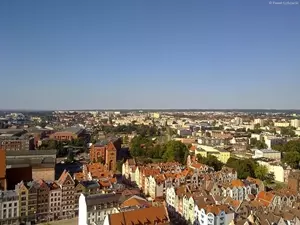 Blick auf Elbląg (Elbing)
Photo: © oben: Pawel Sutkowski/wikimedia.de/CC 3.0; unten: JanuszJ./wikimedia.de/CC 3.0
Blick auf Elbląg (Elbing)
Photo: © oben: Pawel Sutkowski/wikimedia.de/CC 3.0; unten: JanuszJ./wikimedia.de/CC 3.0
During its founding phase in the early 13th century, Elbing lay on the Amber Road. The city became a destination for numerous immigrants from western Europe. After the First World War, the city was incorporated into East Prussia and remained German until 1945.
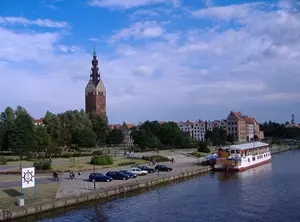
Despite being damaged in the Second World War, numerous historic buildings have survived and have been largely restored. These include St Nicholas Cathedral, the Church of the Holy Spirit Hospital, numerous town houses and the ruins of the Dominican monastery.
Elbląg (Elbing) has earned an international reputation for public art. Sculptures by Polish and international artists can be found on the city's streets and squares, shaping the cityscape of Elbląg (Elbing) to this day.
In 2013, the Lagoon Railway was revitalised, running along the Vistula Lagoon to Kadyny, just outside Tolkmicko (Tolkemit). Elbląg (Elbing) is also an ideal starting point for an extended holiday in the Masurian Lake District.
You can book a hotel in Elbląg (Elbing) directly.
