
Gdańsk (Danzig)
With a population of more than 460,000, the city at the edge of the Vistula estuary is unquestionably the center of all northern Poland and the Polish Baltic coast. Together with the neighboring cities to the north, Sopot (Zoppot) and Gdynia (Gdingen), it forms the so-called Tricity (Trójmiasto), with a population of 760,000. During its exceptionally eventful history, Gdańsk was one of the most important Hanseatic cities. To this day, Gdańsk (Danzig) is also the region’s tourist center, closely connected with the seaside resort of Sopot (Zoppot).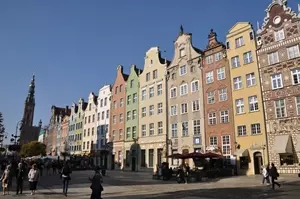
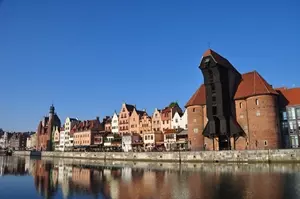 Danzig, Krantor und andere Gebäude an der Mottlau
Photo: © nordlicht verlag (3)
Danzig, Krantor und andere Gebäude an der Mottlau
Photo: © nordlicht verlag (3)
The main attraction is the Old Town, which consists of several areas dating from different periods. The most frequently photographed sights are the banks of the Motława, a tributary of the Vistula, with the Crane Gate and other historic buildings, as well as Long Street, also known as the Royal Route. This is the world’s longest surviving medieval urban thoroughfare, lined with city gates and historic buildings, and leading to Long Market (Długi Targ). Built between 1343 and 1502, St. Mary’s Church was considered the world’s largest Evangelical Lutheran church until 1945.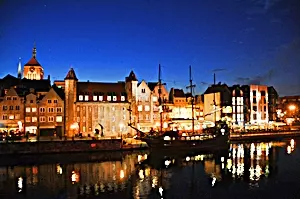
The port of Gdańsk (Danzig) is the largest in Poland. A ferry also runs from here to the Swedish city of Nynäshamn, on the opposite side of the Baltic Sea. Gdańsk (Danzig) is the starting point of the Baltic–Adriatic EuroVelo 9 route, also known in Polish as the Amber Route (Szlak bursztynowy), which runs from here to the Adriatic. The city also lies on EuroVelo 10, the Baltic Sea Cycle Route.
You can book hotels in Gdańsk (Danzig) directly.
