
Frombork (Frauenburg)
Frombork (Frauenburg) connects its cathedral hill with the history of astronomer Nicolaus Copernicus and its setting on the Vistula Lagoon. This Polish town is especially well suited to a cultural-history visit: the cathedral, Copernicus sites and museum are close enough to explore together as part of a single theme.
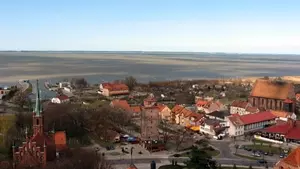 Blick über Frombork auf das Frische Haff
Photo: © oben: Tomek Zakrzewski/wikimedia.de/CC 1.2; Mitte: Lestath/wikimedia.de/CC 3.0; unten: Piotr Kowalski/wikimedia.de/CC 3.0
Frombork at a glance
- Location: Frombork lies in the Warmian-Masurian Voivodeship on the coast of the Vistula Lagoon.
- Landmark: The fortified cathedral hill, with its archcathedral, defines the town’s skyline.
- Connection to Copernicus: The astronomer lived and worked in Frombork as a member of the cathedral chapter; the final period of his life and work was closely tied to the town.
- Culture: The Nicolaus Copernicus Museum focuses on his life and work and operates several exhibition sites.
- Travel profile: Frombork is especially suited to visitors interested in architecture, the history of science and the lagoon.
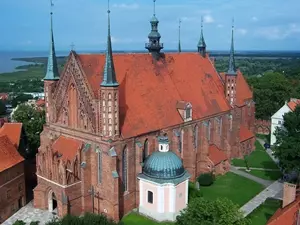 Cathedral Hill: the cathedral and chapter complex
Cathedral Hill is the best place to start to understand Frombork’s history in its physical setting. The Gothic Archcathedral Basilica of the Assumption of the Blessed Virgin Mary and St Andrew stands within a fortified complex above the town. Together with the cathedral chapter buildings, it forms an ensemble where ecclesiastical architecture meets the former administration of Warmia.
When visiting, it is worth setting aside time for both the interior and the grounds. Perched on the hill, the cathedral is a landmark visible from the town; from above, you can appreciate how it relates to the other buildings on Cathedral Hill. Concerts and services may affect access.
Copernicus in Frombork
Nicolaus Copernicus came to Frombork in 1510 and joined the Warmian cathedral chapter. Alongside his ecclesiastical and administrative duties, he pursued astronomical studies. His major work De revolutionibus orbium coelestium developed the idea that the Earth moves around the Sun. Frombork is therefore a place where the history of science can be connected with the everyday life of a Renaissance scholar: Copernicus was active here not only as an astronomer but also took part in the work of the chapter.
The Nicolaus Copernicus Museum presents its themes across several sites. The former Bishop’s Palace on Cathedral Hill houses exhibitions; other museum spaces explore subjects including the history of medicine and astronomy. Visitors wishing to learn more about Copernicus can combine a visit to the cathedral with the museum exhibitions.
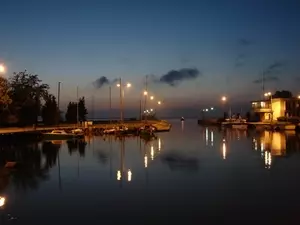 The town, the lagoon and the wider region
Below Cathedral Hill, the town lies on the Vistula Lagoon. Frombork thus combines a compact historic centre with the surrounding lagoon landscape. A walk between the town centre and the shore complements a visit to the cathedral complex with views of the water. The regional picture also includes the Polish Vistula Spit and the Kaliningrad Region. This helps put the historical and present-day borderlands around the lagoon into context.
At the outlet to the Baltic Sea lies Baltiysk (Pillau), connected to the lagoon by the strait. The town is part of the Kaliningrad Region. For visitors to Frombork, this connection is primarily of geographical interest: the lagoon, the spit and the Baltic Sea form one continuous coastal region, now divided by national borders.
The Vistula Spit also adds a different coastal landscape to a visit. The Polish town of Krynica Morska lies on the spit and offers a fitting contrast to Frombork’s cultural and historical character. The two places represent different sides of the region: Cathedral Hill and the history of science on one hand, and the spit and Baltic coast on the other.
Planning your stay
For a first visit, focus on Cathedral Hill, the cathedral and the museum. If you want to explore Copernicus in more depth, allow extra time for the relevant exhibitions. A walk by the lagoon makes a peaceful end to the visit or a pleasant break between sights. With a longer stay, you can combine Frombork with other places in Warmia and Masuria.
Frombork is an interesting base for an overnight stay if you want to combine history and landscape right by the lagoon. You can compare accommodation in Frombork to suit the length of your planned stay. For a day trip, the focus is instead on the order of your visit to Cathedral Hill, the museum and the waterfront path. This way, you can tailor your plans to your own interests.
Frequently asked questions about Frombork
What is Frombork best known for?
Frombork is best known for its fortified Cathedral Hill and Gothic cathedral, and for Nicolaus Copernicus, who lived here as a canon and pursued his astronomical work. The museum offers more on these scientific and cultural-historical connections.
How can you plan a visit to Frombork?
A good plan is to tour Cathedral Hill, including the cathedral and its associated museum sites. Afterwards, take a walk through town or along the lagoon. If you are especially interested in Copernicus, allow extra time for the museum exhibitions.
Is Frombork a good fit for a seaside holiday?
Frombork lies on the Vistula Lagoon and adds architecture, local history and science to a coastal holiday. If you also want to experience Baltic beaches and the landscapes of the spit, you can combine your stay with a visit to another place on the Vistula Spit.
