
Marstrand
Marstrand lies around 45 kilometres northwest of Gothenburg on Sweden’s west coast. The town stretches across Koön and car-free Marstrandsön: the ferry, Carlsten Fortress, historic lanes and paths over the skerry rocks shape a visit. You can plan your time here as an island excursion, a hiking stop or a multi-day coastal stay.
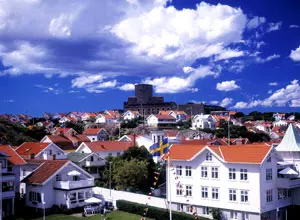 Festung Carlsten in Marstrand an der schwedischen Westküste
Photo: Kjell Holmner, Göteborg & Co IMAGEBANK
Marstrand at a glance
- Location: A west-coast town in Kungälv Municipality, around 45 kilometres northwest of Gothenburg.
- Islands: The town is on Koön and Marstrandsön; the old town and fortress are on the car-free island.
- Ferry: The passenger ferry connects Koön and Marstrandsön; the crossing takes only a few minutes.
- Highlight: Carlsten Fortress towers above the lanes and harbour.
- On foot: A roughly five-kilometre hike loops around Marstrandsön; Koön has trails of varying difficulty.
- What to do: Sailing, harbour life, fortress history and coastal walks come together here.
Two islands, one short ferry ride
Koön is accessible by road and serves as the practical starting point for car-free Marstrandsön. The Marstrandsfärjan runs between the ferry terminal on Koön and the landing in town. The short crossing takes you straight to the waterfront lanes; from there, continue on foot to the fortress or out onto the coastal trails. If you arrive by car, leave it on Koön and explore Marstrandsön on foot.
This layout matters when planning your day: the harbour, town centre and fortress are on the island, while car access ends on Koön. For a short visit, you can combine the town centre and fortress; if you also want to hike, set aside time for the loop as a separate, longer activity.
Carlsten Fortress and the history of the seaside resort
Carlsten Fortress stands prominently on the heights above Marstrandsön. Construction began in the mid-17th century, after Sweden took control of Bohuslän following the Peace of Roskilde. Its location shapes the visit: from the landing, the route leads through the lanes and then steeply uphill to the fortress. If you plan to visit, allow time for the climb, the views and the historic rooms.
Below the fortress, the streets and houses preserve the character of a traditional coastal town. Marstrand became a popular seaside resort in the 19th century; villas and public bathing facilities recall that era. Today, sailboats and the large harbour also define the townscape.
Coastal trails on Marstrandsön and Koön
The loop around Marstrandsön is about five kilometres long and combines nature with local history. Along the way are the narrow rock cleft Smuggler’s Cleft and Trollskogen forest; views of the fortress and sea open up time and again. The route is ideal for visitors who want to experience Marstrand beyond its lanes. At designated spots, you can combine the walk with a swim.
Koön has three marked hiking trails of varying difficulty, the longest around five kilometres long. The routes cross rocky terrain and pass viewpoints, including spots with views of Pater Noster Lighthouse and the neighbouring islands. Koön thus offers a second hiking option, while the loop on Marstrandsön stays closer to the fortress and town centre. If you have less time for walking, choose just a section near the ferry terminal.
Marstrand as a stop on Sweden’s west coast
A stay in Marstrand is especially appealing if you want to combine island trails, harbour atmosphere and historic architecture. For an overnight stay, you’ll find accommodation in Marstrand; whether you stay on Koön or Marstrandsön determines if the ferry crossing is part of your daily routine. Staying here gives you time for the fortress, lanes and a hike, while a day trip limits you to a few stops.
If you continue your journey along the coast, you can compare this harbour town with Smögen and Hunnebostrand: other harbour towns and the granite coastline take centre stage there. Lysekil adds a location on Gullmarsfjord to the route. Farther north, Strömstad and the Koster Islands pair with Kosterhavet National Park; Tanum offers a cultural and historical focus with its Bronze Age rock carvings. For a city break with a coastal excursion, Gothenburg makes a fitting urban counterpart.
Frequently asked questions about Marstrand
How do you get from Koön to Marstrandsön?
The Marstrandsfärjan connects the two islands. The crossing takes a few minutes; once on Marstrandsön, continue on foot from the landing to the town centre, fortress and coastal trails.
How much time do you need for a visit?
Set aside a day for the town centre and fortress. If you also want to walk the roughly five-kilometre loop on Marstrandsön, allow extra time for the trail and breaks. The exact duration depends on whether you visit the fortress and how long you linger along the way.
Can you drive on Marstrandsön?
Marstrandsön is car-free. Visitors reach the island by passenger ferry from Koön and continue on foot; cars are left on Koön.
