
Tanum
The municipality of Tanum in northern Bohuslän on Sweden’s west coast is not only the largest in the region, but also encompasses all the landscape types found there. It stretches from the harbour towns of Hamburgsund, Fjällbacka and Grebbestad to the Bullare Lakes, impressive, elongated inland lakes not far from the coast. The municipality is best known for its 3,000-year-old Bronze Age rock carvings at Vitlycke, which have been a UNESCO World Heritage Site since 1994.
Hamburgsund was once an important port for exporting granite, and a stone-carving workshop where visitors can watch the craft is still one of the town’s attractions. South of the town, you can visit the ruins of the former Viking fortress Hornborgs Slott. Every year, on the first weekend in August, it hosts Viking games and a Viking market. Near the fortress ruins is the Viking village of Hornbore by, with buildings constructed in the Viking style. Its boathouse is unique in the world.
Fjällbacka is said to have Sweden’s most beautiful archipelago. The small holiday resort nestles against 76-metre-high Vetteberget, offering incomparable views over the archipelago. Scenes from the film “Ronia, the Robber’s Daughter” were shot here, and a bust of actress Ingrid Bergman stands in the market square. She had a holiday island just off Fjällbacka.
Grebbestad is Sweden’s oyster town: 80 percent of all oysters harvested in Sweden pass through its fishing harbour. Grebbestad has been a seaside resort since 1844 and is now the municipality’s most popular holiday destination. The long pier welcomes numerous pleasure boaters and is the starting point for trips through the archipelago as far as the Väderöarna, or Weather Islands, with their seal rocks. Kayaks are available for hire, making it possible to explore the archipelago independently.
The Vitlycke Museum is located not far from Tanumshede, off the E6. Some of the best-known Bronze Age rock carvings can be seen on the grounds. The museum provides information about the period when these carvings were created. Found across much of northern Europe, they are known in Sweden as “hällristningar.”
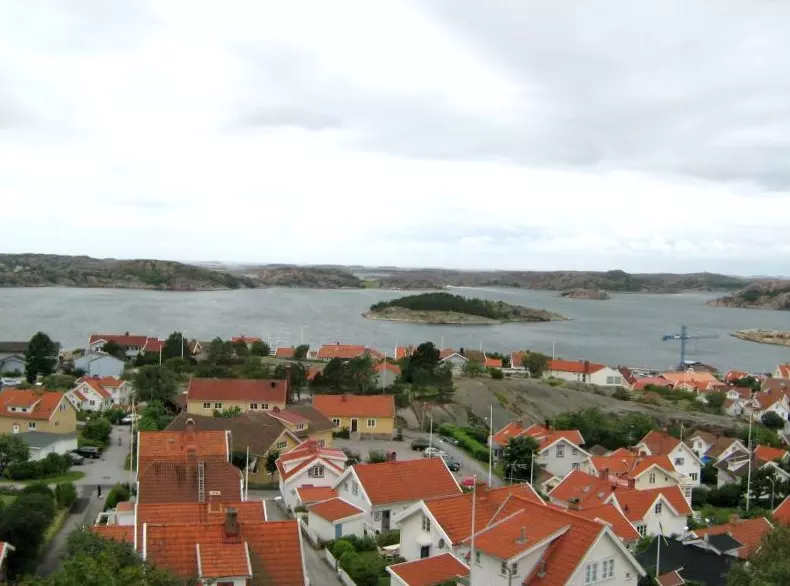 Blick auf Fjällbacka
Photo: © Wikimedia / Tine CC BY-SA3.0
Blick auf Fjällbacka
Photo: © Wikimedia / Tine CC BY-SA3.0
