
Båstad: Tennis History and Coastal Scenery
Båstad lies on the Bjäre Peninsula on Sweden’s west coast, where the Hallandsåsen ridge slopes down towards Laholm Bay and the Kattegat. Tennis history, a long-established harbour town and distinctive coastal and woodland landscapes give a visit a variety of possibilities.
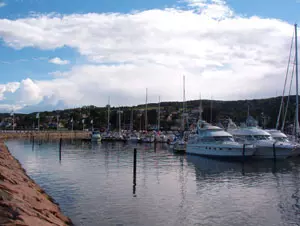 Båstad, Blick auf den Hafen
Photo: © wikimedia Fred J
Båstad at a glance
- Location: Båstad is in Skåne, on Laholm Bay by the Kattegat on Sweden’s west coast.
- Townscape: The harbour and older streets in the centre connect this coastal town with its history.
- Tennis: Sveriges Tennismuseum explores the history of tennis in Sweden.
- Coastal paths: Kustslingan and Båstad Runt pass close to the sea and through different parts of town.
- Hiking: Axeltorpsslingan starts in Båstad and leads into the forests and ravines of Hallandsåsen.
- Day trip: Hovs Hallar adds cliffs, pebble beaches and coastal paths to a visit to the area.
Båstad between the Kattegat and Hallandsåsen
Its location explains why Båstad brings the coast and uplands together so closely. The town lies at the northern edge of the Bjäre Peninsula; beyond the shoreline, the land rises towards Hallandsåsen. From Laholm Bay, views open out across the Kattegat. This gives Båstad a different landscape from the Baltic Sea towns in the narrower sense: it is a coastal town on Sweden’s west coast. Torekov is another harbour town on the Bjäre Peninsula, while the coastal setting and nature at the edge of the peninsula take centre stage in Kattvik.
The harbour, square and older streets are all close together in the centre. The harbour offers a direct link between town life and the water; from there, you can continue your walk through the lanes. If you want to combine seaside paths with exploring the town on foot, this compact layout makes a convenient starting point. The accommodation overview for Båstad helps you plan a stay in town.
Tennis history and local culture
Båstad has close ties to Swedish tennis. Sveriges Tennismuseum documents its history through objects and documents from different periods. A visit to the museum offers a cultural introduction to the sport that has made the town’s name known internationally. Combined with a walk around the harbour and centre, it puts tennis history in the context of the town’s development rather than making your stay solely about a tournament.
Crafts and art are also part of the cultural offering. Handwoven rugs and tapestries are made at the studio of Märta Måås-Fjetterström. Lilla konstslingan is a public art trail through the centre, while another cultural walk links the old town with Malenskogen. You can extend a walk to suit your interests: from the harbour and local history to public art, or along the transition from town to woodland.
Coastal paths and nature around Hallandsåsen
For a short outing by the sea, try Kustslingan, which follows the coast around the eastern part of Båstad. Båstad Runt is a roughly nine-kilometre circuit linking the old western part of town with Malenskogen to the east. For a longer hike, consider Axeltorpsslingan: it starts in town, is nine kilometres long and leads to Axelstorps skogar Nature Reserve on the north-western slope of Hallandsåsen. Here, beech woods and stream ravines mark the shift from coast to wooded ridge.
Another option is Bjäre banvall, between Båstad and Förslöv. This 14-kilometre route follows a former railway line and is designated for walking, cycling and horse riding. It passes through Grevie; the mostly paved route is also suitable for wheelchairs and pushchairs. This makes it an easy-to-plan option for a longer outing without steep coastal paths. In nearby Grevie, the ridges of Grevie åsar and the historic railway village offer a different perspective on the peninsula.
Day trips to Hovs Hallar and Hallands Väderö
North-east of Torekov, Hovs Hallar Nature Reserve lies at the outermost edge of the Bjäre Peninsula. Cliffs, rounded stones, cave formations and coastal meadows define the landscape, while marked trails cross the heights and follow the shore. The municipality describes the seven-kilometre circular route as moderately difficult, with narrow paths and slopes. The path down to the beach can be challenging, so Hovs Hallar is best suited to a hiking day with sturdy footwear and time to take in the changing viewpoints. The rocky scenery is also known as the setting for the opening scene of Ingmar Bergman’s film “The Seventh Seal”.
Hallands Väderö offers another nature excursion off the coast near Torekov. The island is a nature reserve; the municipality says visitors can arrive by ferry or private boat. This makes it easy to combine the trip with a stay in Torekov. When planning your day, it helps to distinguish between the coastal paths and cliffs of Hovs Hallar and an island visit featuring grazing land, rocky shores and woodland.
Frequently asked questions about Båstad
Is Båstad on the Baltic Sea?
Båstad lies on Sweden’s west coast, on Laholm Bay, which forms part of the Kattegat. Its position on the Bjäre Peninsula connects the town with the coast around Torekov and Kattvik.
Which trails start in Båstad?
The nine-kilometre Axeltorpsslingan starts in Båstad and leads into the woodlands of Hallandsåsen. For a longer outing on a mostly paved route, the 14-kilometre Bjäre banvall connects Båstad with Förslöv via Grevie.
What can you combine on a first visit?
A walk around the centre and harbour pairs well with Sveriges Tennismuseum or a section of Kustslingan. For a full day trip, choose between the hiking trails at Hovs Hallar and the nature of Hallands Väderö, depending on your interests.
